Best Payment Gateways in India 2026: Razorpay vs Cashfree vs PayU vs Juspay
India's payment gateway market hit $2.31 billion in 2026, with UPI processing 23.2 billion transactions per month. For D2C brands, choosing the right payment gateway is not about finding the cheapest TDR. It is about maximizing payment success rate, which directly determines how much revenue you actually collect.
Most comparison articles list features and pricing side by side and call it a day. This guide goes deeper. We compare 11 payment gateways across the metrics that actually matter for Indian D2C brands: success rate, UPI handling, settlement speed, smart routing, COD-to-prepaid support, and total cost of ownership.
1. Why Success Rate Matters More Than TDR
Before we compare gateways, let's address the most common mistake D2C founders make: optimizing for TDR (Transaction Discount Rate) instead of success rate.
Consider a D2C brand doing ₹50 lakh in monthly GMV:
- Scenario A: Switch to a gateway with 0.25% lower TDR. Savings: ₹12,500/month.
- Scenario B: Improve payment success rate by 1% (say, 94% to 95%). Recovered revenue: ₹50,000/month.
Scenario B generates 4x more value than Scenario A. And that is just a 1% improvement. Many D2C brands operating on single-gateway setups have success rates of 85-90%, meaning they are losing 10-15% of all attempted payments. That is ₹5-7.5 lakh per month in revenue that customers tried to give them but couldn't.
This is why our comparison prioritizes success rate, retry logic, and routing intelligence over headline TDR. The cheapest gateway that drops 5% more transactions is the most expensive gateway you can choose.
2. The 11 Payment Gateways Compared
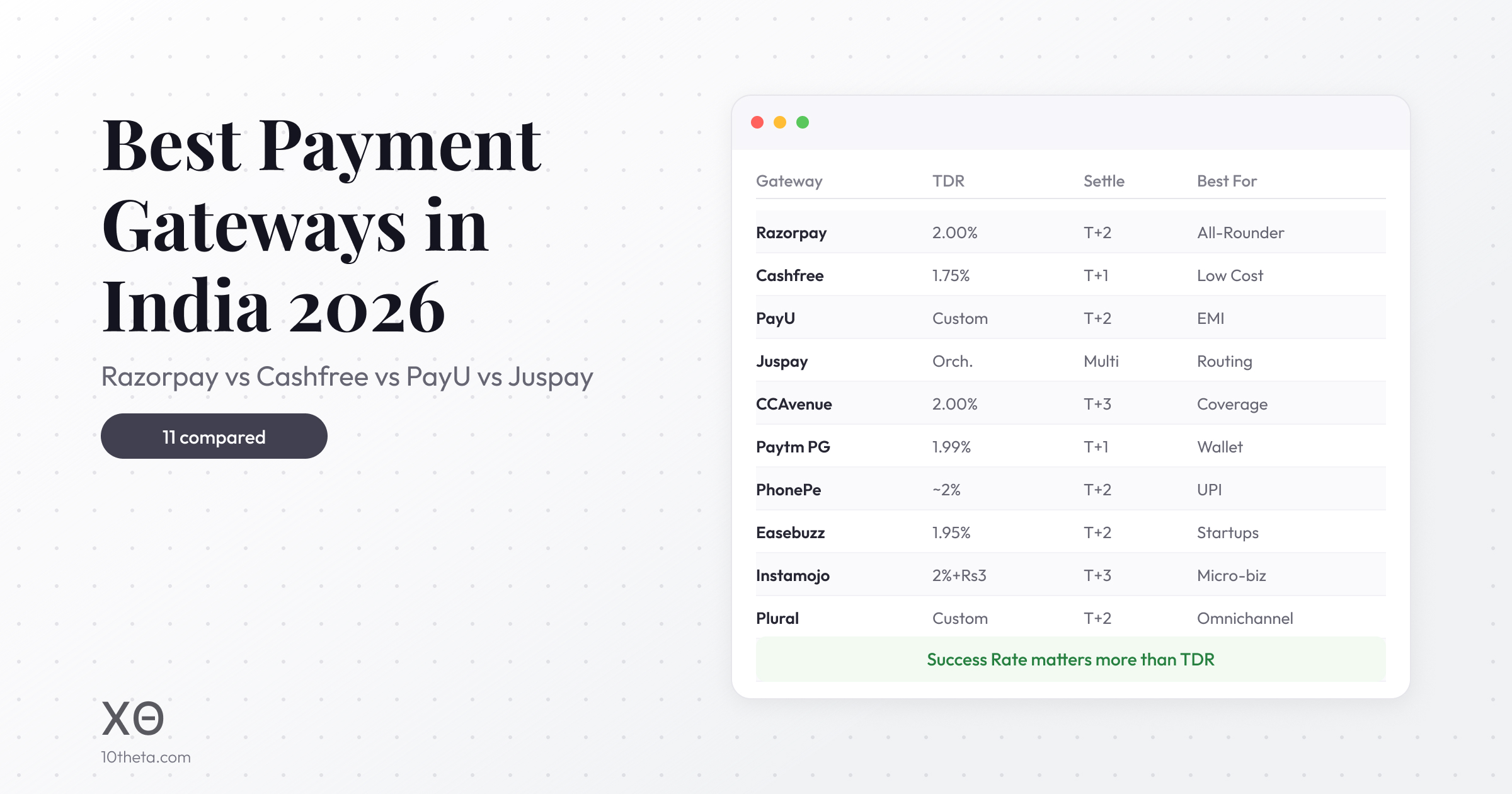
Here is a quick overview of every major payment gateway available for Indian D2C brands in 2026, followed by detailed breakdowns.
| Gateway | TDR (Domestic) | Settlement | Best For |
|---|---|---|---|
| Razorpay | 2% | T+2 (T+0 available) | Most D2C brands, best all-rounder |
| Cashfree | 1.75-1.95% | T+1 to T+2 | Cost-sensitive, high-volume sellers |
| PayU | Negotiated | T+2 | Enterprise, EMI-heavy catalogs |
| Juspay | Orchestration layer | Via underlying PG | Multi-gateway routing, 50L+ GMV |
| CCAvenue | 2% | T+3 | 200+ payment options, legacy businesses |
| Paytm PG | 1.99% | T+1 to T+3 | Paytm wallet user base |
| PhonePe PG | ~2% | T+2 | UPI-heavy brands, PhonePe user base |
| Easebuzz | 1.95% | T+2 | Startups, simple integration |
| Instamojo | 2% + ₹3 | T+3 | Micro-businesses, payment links |
| Plural (Pine Labs) | Negotiated | T+2 | Omnichannel, POS + online unification |
| Stripe India | 2% | T+2 | Global-first brands, international payments |
Note: UPI transactions carry 0% TDR as mandated by RBI. The TDR rates above apply to cards, netbanking, and wallets. All rates are pre-GST.
3. Razorpay - Best All-Rounder for D2C
Razorpay is the default payment gateway for Indian D2C brands, and for good reason. It has the widest platform integration ecosystem (native Shopify, WooCommerce, Magento plugins), the cleanest API documentation, and consistently high UPI success rates.
Key strengths:
- UPI success rate: Among the highest in the industry. Native UPI intent flow works smoothly on mobile.
- Instant settlements: T+0 (same-day) settlement available for a small fee. Standard is T+2.
- Shopify integration: Native app, no custom code needed. Supports all Shopify checkout flows including checkout extensions.
- Magic Checkout: One-click checkout overlay that pre-fills address and payment, reducing checkout time to under 30 seconds.
- Route (Payments Orchestration): Razorpay's own multi-gateway router, though it primarily routes within Razorpay's network.
- COD support: Built-in COD intelligence with RTO prediction scoring.
Limitations:
- TDR at 2% is higher than Cashfree's published rate
- Customer support quality has dropped as they've scaled. Response times for non-enterprise accounts can be slow.
- Payout fees are separate and add up for marketplace-style businesses
Best for: D2C brands on Shopify or WooCommerce doing ₹5-50 lakh monthly GMV who want reliability over cost savings.
4. Cashfree - Best for Cost-Conscious Sellers
Cashfree has positioned itself as the cost-efficient alternative to Razorpay, with TDR rates 0.05-0.25% lower across payment methods. For high-volume sellers, that difference adds up.
Key strengths:
- Lower TDR: 1.75-1.95% for domestic transactions vs Razorpay's 2%. On ₹50 lakh monthly GMV, that saves ₹2,500-12,500/month.
- Auto-retry: 3-attempt automatic retry on declined card transactions. Cashfree claims this delivers 15% higher payment success rates.
- Payouts: Industry-leading payout infrastructure. Vendor payments, refunds, and splits are faster and cheaper than Razorpay's.
- Verification suite: Built-in KYC, PAN verification, and bank account validation. Useful for marketplaces and COD verification.
- 180+ payment modes: Supports niche wallets, regional banks, and BNPL providers that Razorpay may not cover.
Limitations:
- Shopify integration is not as polished as Razorpay's native app
- Smaller ecosystem of plugins and third-party integrations
- Brand recognition is lower, which can matter for customer trust during checkout
Best for: D2C brands doing ₹25 lakh+ monthly GMV where the TDR difference becomes meaningful. Also strong for marketplace models that need advanced payout capabilities.
5. PayU - Best for EMI and Enterprise
PayU doesn't publish standard pricing, which signals its focus on enterprise and high-volume accounts where rates are negotiated. Where PayU genuinely differentiates is EMI.
Key strengths:
- EMI options: The widest bank tie-ups for no-cost EMI and low-cost EMI in India. If you sell products above ₹3,000 and EMI conversion matters, PayU is hard to beat.
- LazyPay BNPL: PayU owns LazyPay, giving it a native Buy Now Pay Later integration that competitors offer through third parties.
- Bolt checkout: One-click checkout with address and payment pre-fill, similar to Razorpay Magic Checkout.
- International reach: PayU operates across 18 countries. If you plan to expand beyond India, having one payment partner for multiple markets simplifies compliance.
Limitations:
- No public pricing makes it hard to compare without reaching out to sales
- Integration documentation is not as developer-friendly as Razorpay or Cashfree
- Smaller presence in the Shopify D2C ecosystem
Best for: D2C brands selling high-AOV products (₹5,000+) where EMI conversion is a meaningful driver of sales. Enterprise brands doing ₹1 crore+ monthly GMV.
6. Juspay - Best for Payment Orchestration
Juspay is not a payment gateway. It is a payment orchestration platform that sits on top of your gateways and routes transactions to maximize success rate. If you are doing ₹50 lakh+ monthly GMV, Juspay is worth serious consideration.
Key strengths:
- Multi-gateway routing: Connect Razorpay, Cashfree, PayU, and others. Juspay routes each transaction to the gateway with the highest real-time success rate for that specific payment method, bank, and amount.
- HyperSDK: Native mobile SDK that eliminates redirect-based payment flows. Keeps the customer inside your app throughout the payment process, reducing drop-offs.
- Express Checkout: Pre-built checkout UI with address and payment pre-fill across the Juspay network.
- Scale proof: Powers payments for ONDC, Swiggy, Flipkart, and other high-volume platforms. Battle-tested at India's highest transaction volumes.
Limitations:
- Adds a layer of cost on top of gateway fees
- Overkill for brands doing under ₹25 lakh monthly GMV
- Integration is more complex than a simple gateway setup
Best for: D2C brands doing ₹50 lakh+ monthly GMV who want to squeeze every percentage point out of payment success rates. Brands already using multiple gateways who need intelligent routing.
7. CCAvenue, Paytm, PhonePe, and Others
CCAvenue
One of India's oldest payment gateways. Supports 200+ payment options including international cards, multi-currency processing, and regional wallets. The integration is dated compared to newer players, and T+3 settlement is slower. Best for businesses that need maximum payment method coverage, especially for international customers buying from India.
Paytm Payment Gateway
Paytm PG at 1.99% TDR is competitive, and the built-in access to Paytm wallet's user base (300M+ users) can boost conversion for brands whose customers already use Paytm. However, Paytm's corporate restructuring in 2024-25 has created uncertainty, and many brands have diversified away from Paytm-only setups.
PhonePe Payment Gateway
PhonePe's PG leverages the largest UPI app (49% market share, 10.3 billion monthly transactions). If your customer base skews heavily toward UPI and PhonePe specifically, their gateway can offer marginally better UPI success rates. The broader payment method support is more limited than Razorpay or Cashfree.
Easebuzz
A startup-friendly gateway with clean documentation and 1.95% TDR. Good for early-stage D2C brands that want straightforward integration without enterprise complexity. Limited advanced features compared to Razorpay or Cashfree.
Instamojo
Best for micro-businesses, freelancers, and one-person D2C operations. Payment links, no-code store builder, and simple setup. Not suitable for brands doing serious volume or needing API-level customization.
Plural by Pine Labs
Pine Labs is India's largest POS provider. Plural unifies online and offline payments into one dashboard. If you have both a D2C website and physical retail or popup stores, Plural gives you a single view of all transactions. Pricing is negotiated for enterprise accounts.
Stripe India
Stripe's India operations support UPI, cards, and netbanking with the same developer-first API quality Stripe is known for globally. Best for brands that sell internationally and want one payment partner across India + global markets. The India-specific feature set (COD intelligence, regional wallets, vernacular checkout) is thinner than Razorpay or Cashfree.
8. How to Choose: Decision Framework
Choosing the right payment gateway depends on your stage, scale, and priorities. Here is a practical framework:
If you're doing under ₹10 lakh/month
Go with Razorpay. The ecosystem, documentation, and Shopify integration make it the fastest to set up. TDR differences at this volume amount to ₹500-2,000/month, which is not worth optimizing for. Focus on getting your checkout working smoothly first.
If you're doing ₹10-50 lakh/month
Start with Razorpay, but add Cashfree as a second gateway. Route UPI through whichever has higher success rates. The TDR savings from Cashfree on cards start to matter at this volume. Consider PayU if EMI is a significant conversion driver for your products.
If you're doing ₹50 lakh+ /month
You should be on multi-gateway routing. Connect 2-3 gateways (Razorpay + Cashfree + PayU is the most common combination) and use an orchestration layer like Juspay or Payθ to route transactions intelligently. At this volume, a 2-3% improvement in success rate is worth ₹1-1.5 lakh/month. Negotiate TDR with each gateway - at ₹50L+ volume, you should be paying 1.5-1.75% on cards, not the published rates.
If you sell internationally
Use Stripe for international transactions and a domestic gateway (Razorpay or Cashfree) for Indian payments. Stripe's international success rates and multi-currency support are superior. For India-to-global D2C, the combination of Stripe (international) + Razorpay (domestic) covers both markets efficiently.
9. Multi-Gateway Routing: The Smart Approach
The smartest D2C brands in India have moved beyond single-gateway dependency. Multi-gateway routing connects your checkout to 2-3 payment gateways and routes each transaction through the one with the highest real-time success rate.
How it works:
- Health monitoring: The routing layer continuously monitors each gateway's success rate by payment method, bank, and transaction amount.
- Intelligent routing: When a customer initiates payment, the system picks the best gateway for that specific transaction. UPI might route through Gateway A while cards route through Gateway B.
- Automatic failover: If a payment fails on one gateway, the system silently retries on another. The customer sees a brief "Processing..." instead of an error.
- Cost optimization: For transactions where multiple gateways have similar success rates, route through the one with lower TDR.
Brands using multi-gateway routing consistently report 5-10% improvement in overall payment success rates. For a brand doing ₹1 crore monthly GMV, that translates to ₹5-10 lakh in recovered revenue per month.
Payθ provides this routing intelligence out of the box, connecting to Razorpay, Cashfree, PayU, and other gateways through a single integration. The AI-powered routing engine learns from your transaction patterns and optimizes routing in real-time.
10. UPI in 2026: The Numbers
Any payment gateway comparison in India must center UPI, because UPI now dominates the payment landscape:
- 23.2 billion transactions/month in May 2026, worth ₹29.9 trillion
- 700+ million daily transactions
- 84.8% of retail digital payment volume in India
- 49% of global real-time payment volume
- 99.2% success rate vs 85-90% for cards and 70-80% for netbanking
PhonePe leads UPI app market share at 49.06%, followed by Google Pay at 33.54%. For D2C brands, this means your checkout must be UPI-first. Show UPI as the default payment option. Trigger UPI intent flow on mobile. Display QR code for desktop. Any gateway you choose must handle UPI flawlessly.
The good news: UPI carries 0% TDR as mandated by RBI. Every transaction that shifts from cards (2% TDR) to UPI (0% TDR) improves both your success rate and your margins. A brand doing 60% UPI, 30% cards, 10% COD has a blended TDR of just 0.6% compared to 1.4% for a brand doing 30% UPI, 50% cards, 20% COD.
11. Settlement Speed Comparison
Settlement speed determines when the money from a sale actually hits your bank account. For bootstrapped D2C brands and brands running sale events, this directly impacts working capital.
| Gateway | Standard Settlement | Instant/Express | Fee for Express |
|---|---|---|---|
| Razorpay | T+2 | T+0 (same day) | Additional fee applies |
| Cashfree | T+1 to T+2 | T+0 available | Additional fee applies |
| PayU | T+2 | T+1 negotiable | Negotiated |
| CCAvenue | T+3 | Not available | - |
| Paytm PG | T+1 to T+3 | T+0 for wallet | Varies |
| Stripe India | T+2 | Not available | - |
During festive season (September-November), when order volumes spike 3-5x, settlement speed becomes critical. A brand doing ₹10 lakh/day during a sale event with T+3 settlement has ₹30 lakh tied up in transit at any given time. With T+1, that drops to ₹10 lakh. The difference can determine whether you can replenish inventory in time for the next wave of orders.
What is the best payment gateway for D2C brands in India in 2026?
For most Indian D2C brands, Razorpay is the best all-round payment gateway in 2026 due to its high UPI success rate, Shopify and WooCommerce integrations, and T+2 settlement. Cashfree offers lower TDR (1.75-1.95% vs 2%) and is better for high-volume sellers. For brands doing 50L+ monthly GMV, Juspay's orchestration layer or Payθ routes across multiple gateways to maximize success rates.
What are the TDR rates for payment gateways in India 2026?
Standard domestic TDR rates: Razorpay 2%, Cashfree 1.75-1.95%, PayU negotiated, CCAvenue 2%, Paytm 1.99%, Easebuzz 1.95%. UPI transactions carry 0% TDR as mandated by RBI. International fees range from 2.5% to 3.9% plus a fixed fee. High-volume merchants (50L+ monthly) can negotiate rates 0.25-0.5% below published rates.
Is payment success rate more important than TDR?
Yes. For a D2C brand doing Rs 50 lakh monthly GMV, a 1% improvement in payment success rate recovers Rs 50,000 in revenue, while a 0.25% reduction in TDR saves only Rs 12,500. Optimize for success rate first (multi-gateway routing, UPI-first checkout, automatic retry), then negotiate TDR.
How does multi-gateway payment routing work?
Multi-gateway routing connects your checkout to 2-3 payment gateways and routes each transaction through the one with the highest real-time success rate for that specific payment method, bank, and amount. Orchestration platforms like Juspay, Plural, and Payθ handle this automatically, typically improving overall payment success rates by 5-10%.
Sources & References
- Mordor Intelligence - India Payment Gateway Market Size & Share Analysis (mordorintelligence.com)
- NPCI - UPI Transaction Statistics and Product Data (npci.org.in)
- CoinLaw - UPI Statistics 2026: 23.2 Billion Monthly Transactions (coinlaw.io)
- MarkNtel Advisors - India Payment Gateways Market CAGR Report (prnewswire.com)
- Razorpay, Cashfree, PayU, Juspay - Official pricing pages and documentation (accessed August 2026)
Related Articles
- Payment Success Rate Optimization for D2C Brands in India
- One-Click Checkout Comparison India: GoKwik vs Shopflo vs Razorpay vs Fastrr
- COD to Prepaid Conversion: The Complete Guide
- D2C Conversion Rate Optimization
- Festive Season D2C Playbook 2026
Stop losing revenue to payment failures.
Payθ routes every transaction through the best-performing gateway in real-time. Multi-gateway routing, automatic failover, and smart COD-to-prepaid nudges.
See Payθ in Action or calculate your revenue leaks for free ›