Festive Season D2C Playbook 2026: Payment, Checkout & Logistics Strategy
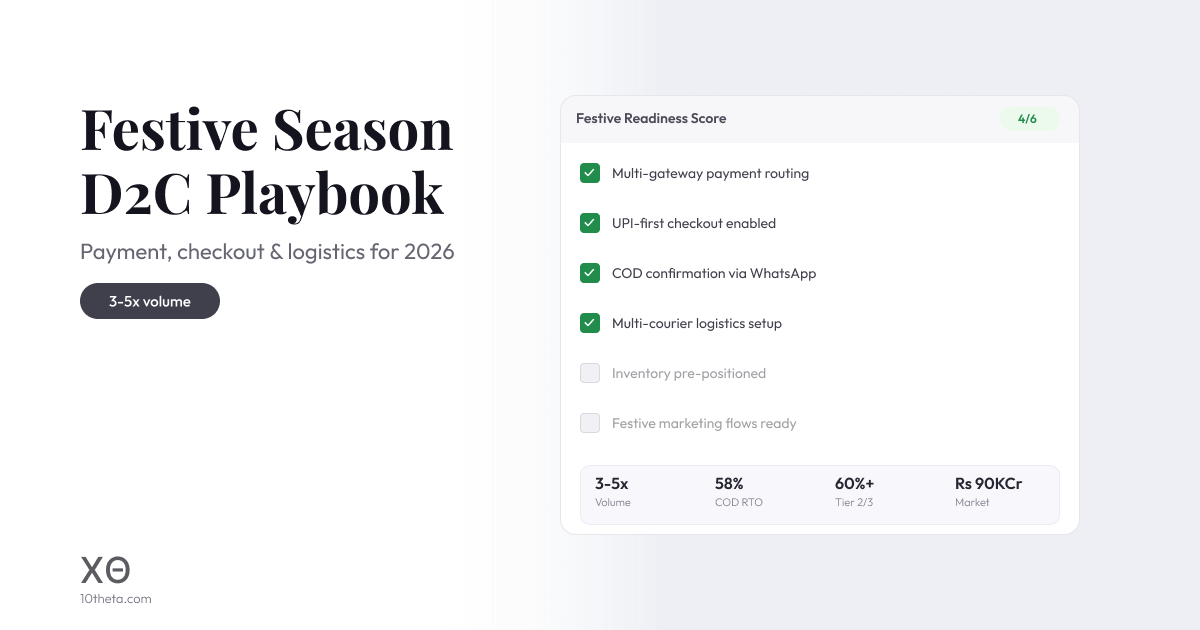
Festive season order volumes jump 3-5x between September and November, with Diwali week alone driving up to Rs 90,000 crore in ecommerce sales. The brands that win aren't the ones that spend more on ads - they're the ones whose payment routing, checkout flow, COD strategy, and logistics don't break under 3x load.
Every year, the September-November festive window separates D2C brands that scale from those that stall. The spike in traffic and orders exposes every weakness in your stack - slow checkout pages, single-gateway payment setups, manual COD verification, and courier partnerships that can't handle volume. This playbook covers every layer you need to prepare before the first sale event goes live.
1. The Festive Calendar
The festive season isn't one event - it's a cascade. Great Indian Festival (Amazon) and Big Billion Days (Flipkart) typically kick off in late September. Navratri follows, then Dussehra, Dhanteras, and finally Diwali in late October or early November. Each event brings a distinct buying pattern: electronics and appliances peak during sale events, fashion and beauty peak during Navratri and Diwali, and gold and jewelry spike on Dhanteras.
For D2C brands, September to November is when 30-40% of annual revenue gets made. Tier-2 and Tier-3 cities now account for 60%+ of festive orders, driven by affordable smartphones and UPI adoption. 85% of festive orders arrive via mobile. If your store isn't optimized for mobile-first checkout on a mid-range Android device with a 4G connection, you're losing the majority of your festive traffic before they even see a product page.
2. Payment Infrastructure for 3x Volume
Your payment gateway that handles 500 transactions per hour during normal days needs to handle 1,500 during festive peak. This isn't a theoretical concern - payment gateway downtime during Big Billion Days and Great Indian Festival has cost brands lakhs in lost revenue in previous years. A single gateway going down during your flash sale means every transaction fails until it recovers.
Single-gateway dependency is catastrophic during festive season. Smart payment routing across Razorpay + Cashfree + PayU ensures that if one gateway experiences downtime or latency spikes, transactions automatically route to the next available gateway with the highest real-time success rate. Payθ handles this routing automatically - monitoring success rates across gateways in real time and shifting traffic within seconds when performance degrades.
UPI now handles 75% of festive payments. Make it your default payment option, not the third tab in your checkout. Ensure UPI intent flow (where the customer's UPI app opens directly) works on all devices - this single optimization can increase payment success rates by 15-20% compared to collect flows where users manually enter UPI IDs.
Pre-festival payment checklist:
- Test gateway load capacity at 3x your current peak
- Set up multi-gateway routing with automatic failover
- Ensure UPI intent flow works on all major Android devices
- Configure payment retry logic for failed transactions
- Set up real-time payment success rate monitoring
3. Checkout Optimization for Speed
Festive shoppers are impulse buyers. They're browsing multiple brands, comparing deals, and making fast decisions. Every extra second at checkout loses more customers than usual - festive cart abandonment rates are 10-15% higher than normal months because shoppers have more alternatives competing for their attention.
One-click checkout for returning customers is non-negotiable during festive season. Address and payment details should be prefilled so the customer taps "Buy Now" and is done. For new customers, the checkout flow should be: phone number, OTP verification, address selection, and payment - four steps maximum. Remove all unnecessary form fields. Nobody needs a "company name" field on a D2C store.
Pre-fill addresses from shopper networks wherever possible. GoKwik claims 200M+ verified addresses, Shopflo has 100M+. When a new customer enters their phone number and their address auto-populates, checkout time drops from 3-4 minutes to under 60 seconds. Cartθ adds progress bars and urgency timers during festive season - showing "Only 3 left at this price" or a countdown timer on flash deals increases conversion by 12-18% during peak sale events.
Load test your checkout page at 3x normal traffic before festive season begins. A checkout page that takes 4+ seconds to load on mobile during peak traffic will hemorrhage conversions.
4. COD Strategy During Festive Season
Here's the number that should keep every D2C founder up at night: COD returns during the festive quarter ran at 58% in 2025. That's not a typo. More than half of all COD orders placed during festive season came back as RTO. The reasons are predictable - impulse purchases made during flash sales, duplicate orders placed across multiple platforms for the same product (customer keeps whichever arrives first), wrong sizes bought in a rush, and "just checking the price" orders where the customer never intended to pay.
Your festive COD strategy needs to be aggressive:
- Prepaid discounts: Offer an extra Rs 100 off for prepaid orders during festive season. This is cheaper than the Rs 200-400 cost of a returned COD order.
- Partial COD: Charge Rs 99 upfront at checkout for COD orders. Customers with genuine intent won't mind. Impulse buyers will drop off - and that's exactly what you want.
- WhatsApp COD confirmation: Send an automated WhatsApp message within 30 minutes of COD order placement asking the customer to confirm. Include a "Convert to prepaid and save Rs 100" option. Orders that go unconfirmed after 2 attempts should be auto-cancelled.
- AI risk scoring: Score every COD order based on customer history, address quality, pin code RTO rate, order value, and time of purchase. Flag high-risk orders for manual review or auto-convert to prepaid-only.
- Block COD for high-risk pin codes: During peak festive days, disable COD for pin codes with historical RTO rates above 40%. The conversion drop is smaller than the RTO cost.
Brands using all five strategies together see festive RTO drop from 58% to 15-20% - saving lakhs in reverse logistics costs. Voiceθ handles COD confirmation calls automatically, reaching customers within minutes of order placement and converting 25-30% of COD orders to prepaid during the call itself.
5. Logistics and Last-Mile
Never rely on a single courier during festive peak. When your courier partner saturates - and they will saturate during Diwali week - your orders stack up in fulfillment limbo. Delivery SLAs stretch from 3-4 days to 8-10 days, customer complaints spike, and cancellation requests flood in.
The minimum festive logistics setup is three courier partners: Delhivery + Shiprocket + Ecom Express (or equivalent). Use pin-code level routing based on each courier's historical performance in that area. Delhivery might deliver faster in Maharashtra while Ecom Express has better success rates in Uttar Pradesh. Smart routing at the pin-code level can reduce delivery failures by 20-30%.
Offer same-day and next-day delivery options for metro cities during festive season. Customers ordering gifts for Diwali on November 1st need delivery by November 2nd - and they'll pay a premium for it. This is where local fulfillment partnerships and dark stores become valuable.
NDR (Non-Delivery Report) management becomes critical during festive season. When a delivery attempt fails, every hour matters. Voiceθ calls the customer within minutes of a failed delivery to reschedule - "Hi, we tried delivering your order today. Would you prefer tomorrow morning or evening?" This simple intervention recovers 40-60% of failed deliveries that would otherwise become RTOs.
6. Inventory and Demand Planning
Stocking out during festive season means losing the sale and often the customer permanently. They'll buy from a competitor, and if that experience is good, they won't come back. On the flip side, overstocking ties up capital in inventory that sits unsold post-Diwali, often requiring deep discounts to clear.
Use previous year's festive data combined with Google Trends and category-level demand signals to forecast by SKU. Fashion and beauty brands should plan for 3-4x normal inventory on bestsellers and 2x on the rest of the catalog. Electronics and gadgets should focus on 2-3x for hero SKUs.
Pre-position inventory in regional warehouses before festive season starts. Having stock in a Delhi warehouse when 40% of your festive orders come from North India means 2-day delivery instead of 5-day delivery. Faster delivery during festive season directly reduces cancellation rates and RTOs.
Set up automatic reorder triggers at safety stock levels. When your bestselling moisturizer drops below 500 units during the Navratri sale, the reorder should trigger automatically - not when someone notices three days later that you're sold out.
7. Marketing and Retention
The biggest mistake D2C brands make during festive season is spending everything on acquisition and nothing on retention. Festive buyers acquired at high CAC are worthless if they never return. The real ROI of festive season is building a customer base that keeps buying after November.
Post-purchase WhatsApp flows are essential. Every festive order should trigger a sequence: order confirmation (immediate), shipping update (when dispatched), delivery confirmation (when delivered), and review request (48 hours after delivery). This flow, automated through Skillθ, keeps your brand in the customer's WhatsApp - the one channel they check 50+ times per day.
Send replenishment reminders 30-45 days after festive purchases. If someone bought a skincare set during Diwali, they'll need a refill by mid-December. If someone bought coffee beans, they'll run out in 3-4 weeks. Time these reminders right and you convert one-time festive buyers into subscribers.
Here's the number that makes retention investment worthwhile: festive buyers who make a repeat purchase within 60 days have 3x higher lifetime value than one-time festive shoppers. Spending Rs 50 on a WhatsApp re-engagement flow is dramatically cheaper than spending Rs 500-800 on acquiring a new customer during peak festive ad rates.
8. The xθ Festive Stack
Each xθ product is built to handle festive-scale volume without manual intervention. Here's how they work together during the September-November window:
- Payθ - Multi-gateway payment routing for 3x load. Automatically shifts transactions between Razorpay, Cashfree, and PayU based on real-time success rates. Ensures UPI intent flow works across all devices.
- Cartθ - Progress bars, urgency timers, and smart nudges optimized for festive AOV. "Add Rs 200 more for free Diwali gift wrapping" increases average cart value by 15-22% during festive season.
- Clareθ - AI shopping agent that handles gift recommendations. When a customer asks "What should I gift my mother for Diwali under Rs 2,000?", Clareθ curates personalized suggestions from your catalog - converting browsing into buying.
- Voiceθ - Automated COD confirmation calls and NDR recovery. Reaches customers within minutes of order placement or delivery failure. Converts 25-30% of COD to prepaid during confirmation calls.
- Skillθ - Automated festive WhatsApp flows: post-purchase sequences, replenishment reminders, flash sale announcements, and abandoned cart recovery. Runs without manual intervention at any volume.
- Insightθ - Real-time revenue dashboard during peak. Track payment success rates, gateway performance, conversion by channel, and RTO rates as they happen - not in next-day reports when the damage is done.
When should D2C brands start preparing for festive season?
Start 6-8 weeks before the first major sale event (Great Indian Festival, typically mid-September). Payment infrastructure and checkout optimization should be tested by August. Inventory should be positioned by early September. Marketing campaigns should be pre-built and scheduled. Brands that start preparation in October are already too late - they'll spend the entire festive season firefighting instead of scaling.
How to reduce RTO during festive season?
COD returns spike to 58% during festive quarter. Reduce with: prepaid discounts (extra Rs 100 off), partial COD (Rs 99 upfront), WhatsApp COD confirmation within 30 minutes, AI risk scoring on every order, and blocking COD for high-risk pin codes. Brands using all five strategies see festive RTO drop to 15-20%. The key is implementing these before festive season starts, not reacting after RTO numbers spike.
Should D2C brands offer discounts during festive season?
Yes, but strategically. Don't discount your hero product - offer bundles, gift sets, and festive-exclusive variants instead. Use tiered discounts (Buy 2 Get 10% Off, Buy 3 Get 20% Off) to increase AOV rather than cutting margins on individual products. Prepaid discounts (extra 5-10% for UPI payment) serve double duty: they increase conversion and reduce COD-related RTO. The goal is higher revenue per order, not lower prices.
How to handle 3x order volume without payment failures?
Set up multi-gateway payment routing before festive season. Connect at least 2-3 payment gateways (Razorpay, Cashfree, PayU). Use smart routing to send each transaction to the gateway with the highest real-time success rate. Test at 3x load in August - don't wait until the first sale day to discover your payment infrastructure can't handle the volume. Ensure UPI intent flow works on all devices, especially mid-range Android phones that your Tier-2/3 customers are using.
Sources & References
- Razorpay - D2C Founders Playbook for Festive Season 2026 (https://razorpay.com/)
- Unicommerce - India D2C Report 2026 (https://unicommerce.com/)
- RedSeer Consulting - Festive ecommerce sales projections Rs 90,000 crore
Related Articles
- How to Reduce Cart Abandonment for D2C Brands
- How to Reduce RTO in eCommerce India
- COD to Prepaid Conversion: Strategies for Indian D2C
- Payment Success Rate Optimization for Indian D2C
- AI Voice Bot for D2C: Cart Recovery, COD Confirmation & Beyond
Festive season breaks brands that aren't ready. Don't be one of them.
xθ handles payment routing, checkout optimization, and COD management so your store doesn't buckle under 3x load.
Get Festive-Ready or calculate your revenue leaks for free ›