Shopify vs WooCommerce for D2C Brands in India (2026)
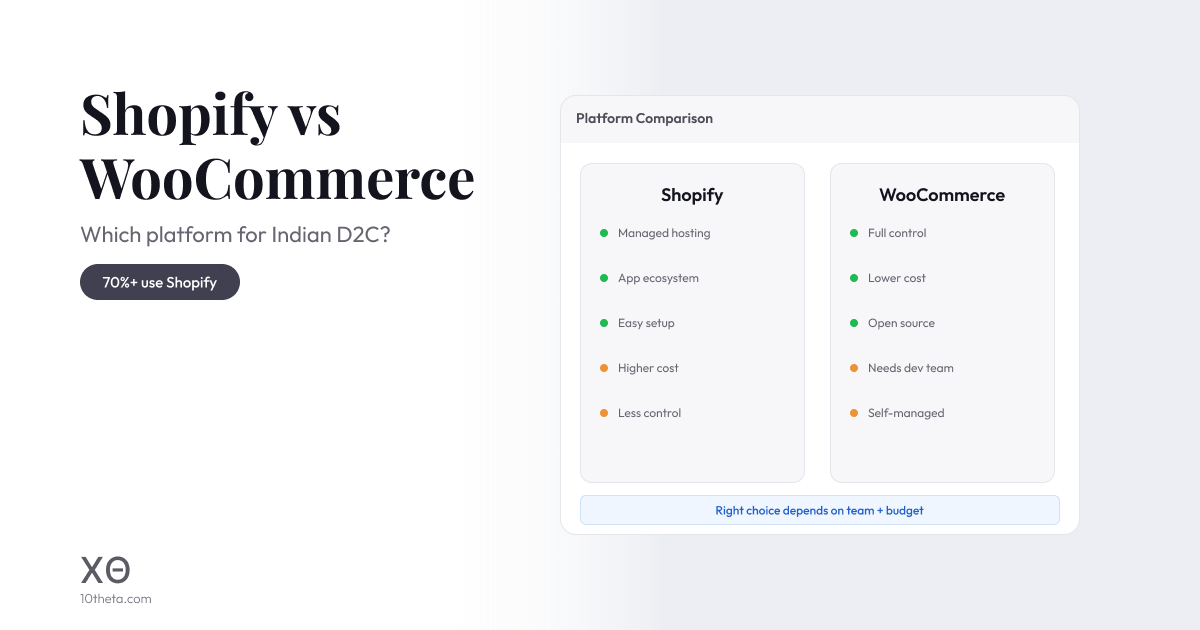
Shopify powers 70%+ of funded Indian D2C brands with its managed infrastructure and app ecosystem, while WooCommerce offers full control at lower cost for brands with technical teams. The right choice depends on your team size, budget, and scaling ambitions.
The platform question is one of the first decisions every Indian D2C founder faces. Shopify or WooCommerce? The answer depends on your team, budget, growth stage, and technical comfort. Both platforms power thousands of successful Indian D2C brands - but they serve different needs. This guide provides an honest, India-specific comparison.
Quick Comparison
- Shopify: Hosted, managed, easier to start. ₹2,000-30,000/month. Best for non-technical founders who want speed.
- WooCommerce: Self-hosted on WordPress, more customizable, lower monthly cost but higher setup effort. Best for teams with technical capability who want full control.
Pricing
Shopify: Basic plan starts at ₹2,000/month ($24/month). Standard plan ₹5,300/month ($69). Advanced ₹22,100/month ($299). Plus transaction fees of 2% on external payment gateways (waived if using Shopify Payments, which is not available in India - so Indian brands always pay the gateway fee on top of their payment processor's fees).
WooCommerce: The plugin is free. Costs come from hosting (₹500-5,000/month for shared to VPS), domain (₹800/year), SSL (free with most hosts), and premium plugins (₹5,000-20,000 one-time for essentials). Total: ₹1,500-10,000/month depending on scale. No transaction fees beyond your payment gateway.
Payment Gateways in India
Both platforms integrate with Indian payment gateways: Razorpay, Cashfree, PayU, and CCAvenue. UPI, cards, net banking, wallets, and BNPL are supported on both. COD is also available through both, with apps/plugins for COD management.
The key difference: Shopify charges an additional 2% transaction fee on top of your gateway fees (unless using Shopify Payments). WooCommerce has no platform transaction fee - you only pay your gateway's rate (typically 2% for Razorpay, 1.9% for Cashfree). For a brand doing ₹50 lakh/month in revenue, that 2% Shopify fee adds ₹1 lakh/month in costs.
Ease of Use
Shopify wins for non-technical teams. Store setup takes 1-2 days. Theme customization is drag-and-drop. App installation is one-click. No server management, no security patches, no uptime monitoring.
WooCommerce requires WordPress knowledge, basic server management, and comfort with plugins. Initial setup takes 3-7 days. But the tradeoff is complete control - you can customize anything, you own your data, and you're not dependent on a platform's decisions.
Scalability
Shopify handles scaling automatically. Whether you do 10 orders or 10,000 orders a day, Shopify's infrastructure manages traffic spikes, security, and performance. Shopify Plus (₹1.6 lakh/month) serves enterprise brands.
WooCommerce scales based on your hosting. Shared hosting fails above 500-1,000 daily orders. VPS or cloud hosting (AWS, DigitalOcean) handles 5,000-10,000+ daily orders but requires DevOps knowledge. Performance optimization (caching, CDN, database tuning) is your responsibility.
The India-Specific Factors
- COD management: Both support COD, but WooCommerce has more flexible COD customization options (conditional COD by pin code, order value, customer history).
- GST compliance: Both support GST invoicing through apps/plugins.
- Shipping integrations: Both integrate with Shiprocket, Delhivery, and other Indian logistics providers.
- Checkout optimization: Both work with xθ's Payθ for smart checkout, COD-to-prepaid conversion, and payment routing. Engageθ
Recommendation
- Choose Shopify if you're a non-technical founder, want to launch fast, prioritize ease over customization, and can absorb the 2% transaction fee.
- Choose WooCommerce if you have technical skills (or a developer), want full control and ownership, need deep customization, and want to avoid platform transaction fees.
- Either way, pair your platform with xθ for smart checkout, cart optimization, AI shopping, and analytics - both platforms integrate seamlessly with 50+ tools via our integrations.
Sources & References
- BuiltWith - Shopify and WooCommerce market share and usage statistics for Indian eCommerce sites (https://builtwith.com/)
- Shopify - India pricing, Shopify Payments availability, and platform performance benchmarks (https://www.shopify.com/in)
- WooCommerce - Open-source eCommerce platform documentation and hosting requirements (https://woocommerce.com/)
Related Articles
- One-Click Checkout Comparison India 2026
- How to Reduce Cart Abandonment for D2C Brands
- D2C Unit Economics: CAC, LTV, AOV Explained
Whichever platform you choose, xθ works with both.
Shopify or WooCommerce - xθ integrates in minutes and starts improving checkout, cart, and retention from day one.
See xθ in Action or calculate your revenue leaks for free ›