AI Product Photography for D2C: Catalogue Without a Shoot
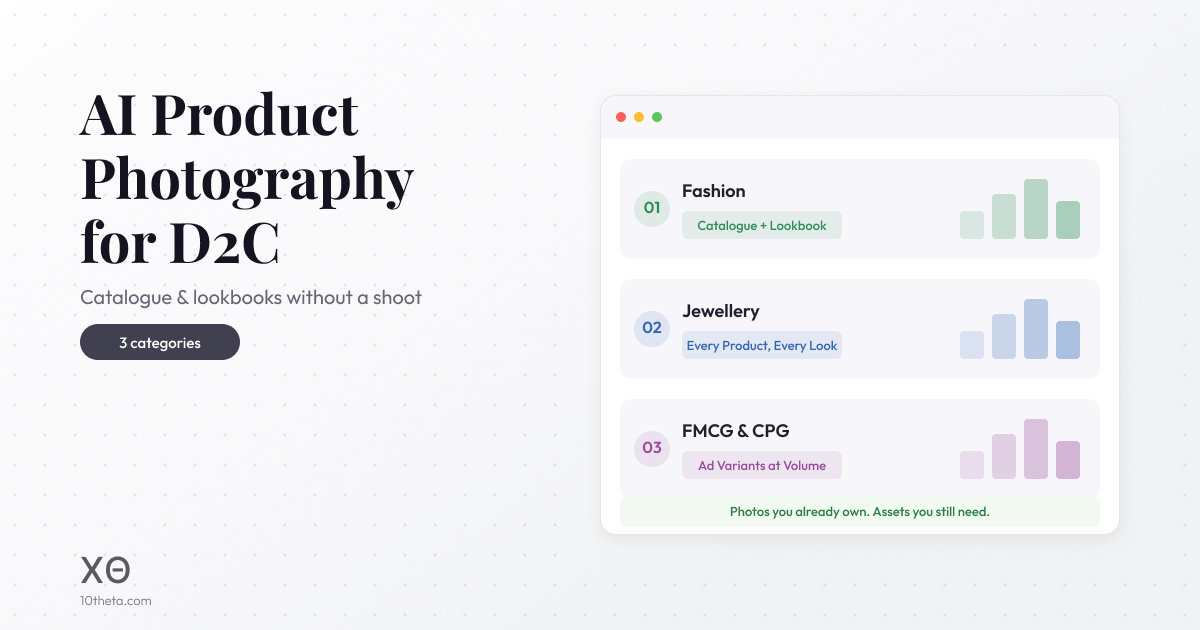
AI product photography generates catalogue images, lookbooks, UGC-style content, banners, and ad variants from product photos you already own. For D2C brands, it removes the studio bottleneck from the launch cycle: shoot a product once, then produce every angle, background, colourway, and channel size without booking a second shoot.
Ask any D2C operator what delays a launch and the answer is rarely the product. It is the creative. The product is manufactured, the inventory has landed, the campaign is planned, and everything waits on a shoot that has not been scheduled yet.
The maths is unforgiving. A brand with 60 SKUs and four launches a year needs catalogue shots in several angles, on-model variants, a lookbook, and platform-specific ad creative for each drop. That is thousands of assets a year from a process measured in weeks.
Why the Shoot Cycle Is the Bottleneck
A conventional catalogue shoot is not one cost, it is a chain of dependencies where every link can slip:
- Scheduling: photographer, studio, and model availability have to align, which is usually what sets the earliest possible date
- Production: studio rental, lighting, styling, props, and sample logistics to get product physically in the room
- Post-production: selection, retouching, background cleanup, and colour correction, typically the longest single stage
- Adaptation: resizing and recomposing every approved asset for each channel, done manually and repeated per campaign
- Revisions: anything missed means either a compromise or a reshoot, and a reshoot restarts the chain
The cost that actually hurts is not the invoice. It is that creative capacity is fixed while SKU count and channel count keep growing. Add a marketplace, add a region, add a festive campaign, and the same pipeline has to absorb it.
What AI Product Photography Actually Produces
The useful framing is not "AI makes images." It is which specific assets it can produce reliably from source photography you already have:
- Catalogue shots: multiple angles and background treatments from a single source image, consistent across an entire SKU range
- 360-degree views: rotational sets for product detail pages without a turntable rig
- On-model variants: the same product shown on different models, poses, and settings
- Lookbooks: composed layouts pairing products into styled looks per collection
- UGC-style content: the casual, phone-shot aesthetic that outperforms polished studio work on social feeds
- Product banners: web hero and display banners sized per placement
- Ad variants: platform-specific performance creative, generated in volume for testing
- Brand and campaign videos: short-form motion built from the same asset set
The channel adaptation matters as much as the generation. An asset that exists only at one aspect ratio still needs manual work before it can ship to WhatsApp, Instagram, and a website hero. Generating the variants and the resizes together is what compresses weeks into minutes.
Where It Works Best
Fashion and Apparel
Highest gain, because fashion carries both problems at once: high SKU count and a launch calendar. Every drop needs catalogue, on-model, and lookbook coverage, and the assets expire when the collection does. Generating colourway variants is especially valuable, since the same garment in six colours is one shoot and five generations rather than six shoots.
Jewellery
Shoot cost scales almost linearly with SKU count here, which makes it the clearest economic case. A jewellery catalogue needs every product in every look, plus on-model context for scale, and macro detail for stones and finish. The caveat is real though: reflective metal and gemstones are the hardest surfaces for generation to keep faithful, so source photography quality matters more in this category than any other.
FMCG and CPG
Different problem entirely. Catalogue depth is not the constraint because the SKU range is usually narrow. Ad variant volume is. Performance marketing needs many creative variants per campaign to test into a winner, and manual production caps how many hypotheses can be tested. Generation lifts that cap, which is where Insightθ matters: variants only compound if you feed conversion data back into what gets produced next.
What It Cannot Replace
This is the part most vendor content skips, and skipping it is why buyers get burned. AI generation has real limits:
- The first shot of a new product: generation works from source imagery, so a product that has never been photographed still needs a camera
- Editorial campaign concepts: a considered creative idea with location, narrative, and art direction is not a variation problem
- Exact material fidelity: texture, weave, sheen, and stone clarity can drift, which matters for high-consideration purchases where the customer is buying on that detail
- Claims-sensitive imagery: anything in food, health, or supplements where the visual carries a regulated claim should not be generated
- Real human endorsement: UGC-style is an aesthetic, not actual customer content, and it should not be presented as a real customer testimonial
The honest operating model is a hybrid. Shoot the hero once, properly. Generate the long tail of variants, resizes, and channel adaptations. That is where the weeks actually go, and it is the part that does not need a studio.
Brand Consistency Is the Hard Part
Any tool can produce a clean product image on a white background. Producing one that looks unmistakably like your brand is the real problem, and it is what separates a usable pipeline from a novelty.
The approach that works is learning the brand from assets that already exist rather than asking someone to write a specification. Your current catalogue already encodes your palette, lighting, background treatment, composition, model direction, and prop language. A brand profile built from that becomes the layer every generation runs through, so output is consistent across SKUs, campaigns, and whoever happens to be operating the tool.
This is how Skillθ handles it: a Brand DNA profile built from your existing catalogue, site, and past campaigns, with the content generation, copy, and campaign pipeline skills all generating through it. Generated assets then flow into Engageθ for WhatsApp campaigns and Insightθ for testing which visuals actually convert.
Getting Started
You do not need to rebuild your creative process to start. The questions worth asking:
- What percentage of your assets are variations? Angles, backgrounds, colourways, and resizes are the generation-friendly majority. If most of your creative volume is variation, most of your creative time is recoverable
- Does the tool learn your brand, or just generate images? If output does not run through a brand profile, you will spend the saved time on rejection and rework
- Does copy ship with the visual? An ad is image plus text. If captions and headlines are a separate manual step, the campaign still waits
- Does performance data feed back in? Variants that never learn from conversion results reset the guesswork every campaign
Start with the highest-volume, lowest-risk category: catalogue variants for an existing collection you have already shot. It is measurable, it is reversible, and it tells you quickly whether the output clears your brand bar before you put a launch on it.
Can AI product photography replace a studio shoot completely?
Not completely, and any vendor claiming otherwise is overselling. AI generation works extremely well for catalogue variation: multiple angles, background swaps, colourway variants, on-model versions, and channel resizes from photos you already own. It does not replace the original hero shot of a brand-new product, true editorial campaign photography with a creative concept, or any image where exact material texture must be legally accurate. The practical model is to shoot once, then generate the hundreds of downstream variants.
How does the AI keep output consistent with my brand?
Through a brand profile built from assets you already have. Skillθ's Brand DNA skill ingests your existing catalogue, website, and past campaigns to learn your palette, lighting, backgrounds, composition, model direction, and prop language. Every generation runs through that profile, which is what separates branded output from generic AI imagery. You do not need a formal brand guidelines document to start.
Which D2C categories benefit most?
Categories with high SKU counts and frequent launches see the biggest gain. Fashion and apparel need catalogue plus lookbook per drop. Jewellery needs every product in every look, where shoot cost scales directly with SKU count. FMCG and CPG need high ad variant volume for performance testing rather than catalogue depth. Furniture and electronics benefit less for hero imagery but still gain on channel resizing and ad variants.
Sources & References
- xθ - Skillθ content generation, Brand DNA, and campaign pipelines (https://10theta.com/products/skill)
- xθ - Insightθ creative performance and A/B testing (https://10theta.com/products/insight)
- Shopify - product photography guidance for ecommerce merchants (https://www.shopify.com/)
Related Articles
- AI Personalization for D2C eCommerce
- Agentic Commerce: AI Agents in eCommerce
- MCP for D2C: How Model Context Protocol Powers AI Agents
- Festive Season D2C Playbook 2026
- D2C Conversion Rate Optimization
Ship campaigns like a team 10x your size.
Skillθ learns how your brand looks and sounds, then generates catalogue, lookbook, UGC-style content, banners, and ad variants from the photos you already have.
See It On Your Catalogue or calculate your revenue leaks for free ›