AI Personalization for D2C eCommerce: The Complete Guide
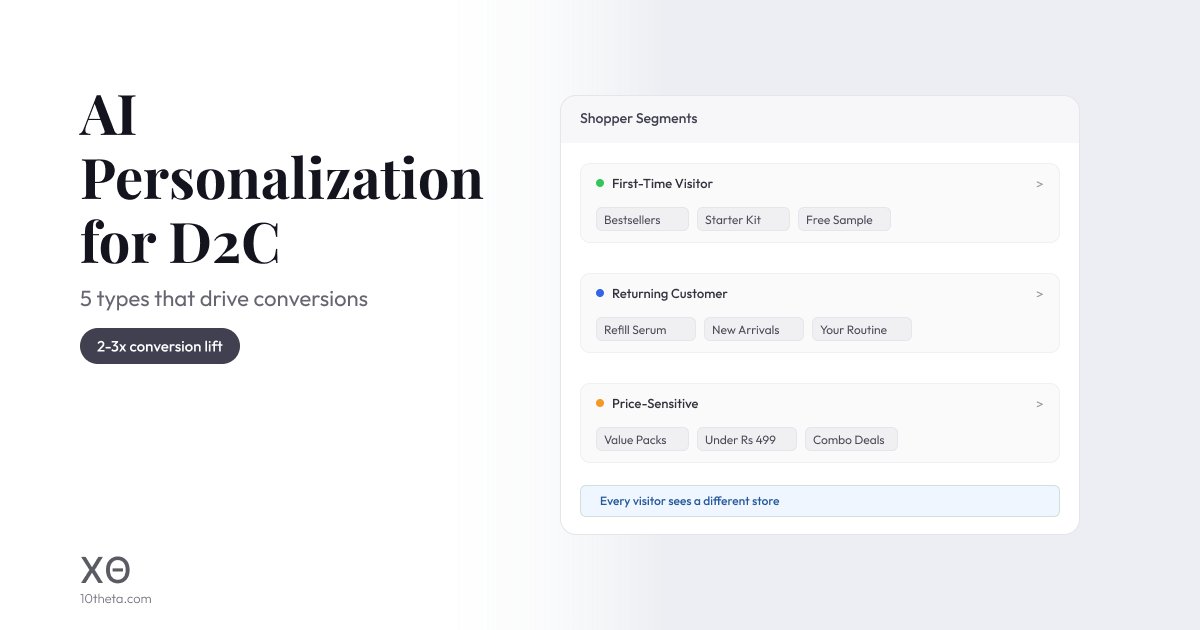
AI personalization delivers 2-3x higher conversion rates, 25% larger average order values, and 3-5x higher email revenue for D2C brands that implement it across product recommendations, search, pricing, content, and notifications.
The era of one-size-fits-all eCommerce is over. In 2026, shoppers expect every interaction with a brand to feel tailored to their preferences, their browsing history, and their intent. Brands that deliver this personalized experience see 2-3x higher conversion rates, 25% larger average order values, and dramatically better customer retention. Those that do not are watching their customers quietly leave for competitors who do.
This guide breaks down everything D2C brand owners need to know about AI personalization: what it is, why it matters, the five most impactful types, and how to get started without a data science team.
What Is AI Personalization in D2C?
AI personalization uses machine learning algorithms to analyze customer data, including browsing behavior, purchase history, demographics, and real-time intent signals, and then automatically tailor the shopping experience for each individual visitor. Unlike rule-based personalization where you manually define segments and triggers, AI personalization adapts continuously and improves with every interaction.
For a D2C brand, this means your store does not show the same homepage, the same product order, or the same recommendations to every visitor. A first-time visitor researching skincare sees educational content and bestsellers. A returning customer who previously bought a moisturizer sees complementary serums and refill options. A price-sensitive shopper sees value bundles, while a premium buyer sees luxury sets. All of this happens automatically, in real time, without any manual effort from your team.
Why Generic Experiences Kill Conversions
Consider the math. A typical D2C store receives 50,000 monthly visitors with a 2% conversion rate, generating 1,000 orders. Of the 49,000 who leave without buying, a significant portion left because the experience was not relevant to them. They saw products they did not care about, recommendations that missed the mark, or content that did not address their specific concerns.
Generic experiences create three specific problems. First, they increase bounce rates because visitors do not see anything immediately relevant within the first few seconds. Second, they reduce session duration because shoppers have to manually hunt for what they want rather than being guided to it. Third, they lower repeat purchase rates because customers have no reason to believe their next visit will be any better than the last. AI personalization directly addresses all three problems by making every touchpoint feel intentional and relevant.
5 Types of AI Personalization That Drive Revenue
1. AI Product Recommendations
Product recommendations powered by AI go far beyond "customers who bought this also bought that." Modern recommendation engines analyze real-time browsing behavior, purchase history, product attributes, and even visual similarity to surface the products most likely to convert each individual shopper. This includes homepage recommendations tailored to returning visitors, product detail page suggestions based on the item being viewed, cart page upsells that complement existing selections, and post-purchase recommendations timed to the customer's replenishment cycle.
The impact is significant. AI-powered recommendations typically account for 15-30% of total eCommerce revenue for brands that implement them effectively. They reduce the cognitive load on shoppers by curating relevant options from what might be hundreds or thousands of SKUs, making the path to purchase shorter and more satisfying.
2. Personalized Search
Site search is one of the highest-intent interactions on any eCommerce store. Shoppers who use search convert at 2-3x the rate of those who browse. AI-personalized search takes this further by reranking results based on each shopper's preferences and behavior. If a customer frequently buys organic products, a search for "face wash" surfaces organic options first. If another customer tends to buy premium products, the same search shows luxury options at the top.
AI search also handles natural language queries effectively. A shopper typing "something for dry skin under 500" gets meaningful results instead of a "no results found" page. This matters enormously for D2C brands because a failed search is almost always a lost sale. The shopper simply leaves and searches on a marketplace instead. Personalized, intelligent search keeps them on your store and guides them to a purchase.
3. Dynamic Pricing and Offers
Not every shopper needs the same incentive to convert. Some will buy at full price, others need free shipping, and some need a discount to push them over the edge. AI-powered dynamic offers analyze each visitor's price sensitivity, cart value, purchase history, and behavior patterns to determine the minimum incentive needed to convert them, or whether any incentive is needed at all.
This is not about showing different prices for the same product. It is about intelligently deploying your promotional budget. A first-time visitor with a high cart value might see a free shipping offer. A returning visitor who abandoned their cart three times might see a 10% discount. A loyal customer might see early access to a new collection instead of a discount. By matching the offer to the shopper's intent and value, you maximize conversions while protecting your margins.
4. Content Personalization
The banners, images, copy, and layout your store shows can all be personalized based on who is viewing them. AI content personalization adapts your homepage hero image, category page layouts, product descriptions, and even email content to match each visitor's preferences and stage in the buying journey.
For a fashion D2C brand, this might mean showing western wear to urban shoppers and ethnic wear to shoppers in smaller cities. For a beauty brand, it could mean featuring ingredient-focused content for educated consumers and result-focused content for casual browsers. Content personalization creates the feeling that your store was built specifically for each visitor, which increases engagement, time on site, and ultimately conversion. When combined with Insightθ analytics, you can measure exactly which personalized content variations drive the most revenue.
5. Personalized Emails and Notifications
Email remains a powerful revenue channel for D2C brands, but only when the content is relevant. AI personalization transforms email from batch-and-blast campaigns into individually tailored communications. Each customer receives product recommendations based on their specific browsing and purchase history, send-time optimization based on when they are most likely to open and engage, and content that matches their demonstrated interests.
AI-personalized email campaigns consistently deliver 3-5x higher revenue per email compared to generic campaigns. The same principle applies to push notifications, SMS, and WhatsApp messages. Every communication channel becomes more effective when the content is tailored to the individual recipient rather than a broad segment.
How xθ Powers AI Personalization with Clareθ
Clareθ is the AI-powered shopping agent built by xθ specifically for D2C brands. Unlike generic personalization tools that require months of data collection and complex setup, Clareθ starts delivering personalized experiences from day one by combining your product catalog data with real-time shopper behavior analysis.
Clareθ operates as a conversational AI agent that engages shoppers directly on your store. It asks intelligent questions to understand preferences, recommends products based on the answers combined with behavioral signals, handles objections about sizing or ingredients or pricing, and guides the shopper through to checkout. Think of it as your best salesperson, available 24/7 for every single visitor, learning and improving with every conversation.
What makes Clareθ different from chatbots is depth of understanding. It does not follow scripted flows. It genuinely understands your product catalog, your brand voice, and each shopper's context. When a customer asks "will this moisturizer work for my oily, acne-prone skin?", Clareθ does not just show a generic FAQ. It analyzes the product's ingredients, cross-references with the customer's stated skin type, and provides a specific, helpful answer, often recommending a better-suited alternative if appropriate. This level of personalization builds trust and drives conversion in a way that static recommendation widgets simply cannot match.
Getting Started: 3 Steps to AI Personalization
Step 1: Audit Your Current Data
Before implementing AI personalization, take stock of what data you already have. Most D2C brands on Shopify or similar platforms are sitting on a goldmine of customer data they are not using: browsing behavior, purchase history, cart data, email engagement metrics, and customer service interactions. Secureθ Identityθ can unify this data into comprehensive customer profiles that power personalization across every touchpoint. You do not need perfect data to start. AI models improve as they collect more data, so the best time to begin is now.
Step 2: Start with High-Impact Touchpoints
You do not need to personalize everything at once. Start with the three touchpoints that have the highest impact on revenue: product recommendations on the product detail page, personalized cart upsells with Cartθ, and abandoned cart recovery messages. These three alone can drive a 15-25% increase in revenue within the first month. Once you see results, expand to homepage personalization, search, and email.
Step 3: Measure, Learn, and Expand
AI personalization is not set-and-forget. Use Insightθ to track the performance of personalized experiences versus generic ones. Monitor conversion rate lift, average order value changes, and customer lifetime value trends. The data will tell you where personalization has the most impact for your specific brand and customer base, guiding where to invest next. Most brands see the full impact of AI personalization compound over 3-6 months as the models learn more about their customers.
Sources & References
- McKinsey & Company - The value of personalization in retail, 25-35% revenue lift from AI-driven personalization
- Barilliance - Product recommendation statistics, AI recommendations account for 15-30% of eCommerce revenue
- Salesforce - Personalization trends in commerce, 2-3x conversion improvement with AI-powered experiences
Related Articles
- AI Product Photography: Catalogue Without a Shoot
- AI in D2C eCommerce: Agentic Commerce Guide
- WhatsApp Commerce for D2C Brands: Complete Guide
- How to Reduce Cart Abandonment for D2C Brands
- One-Click Checkout Comparison India 2026
- MCP for D2C: How Model Context Protocol Powers AI Agents
- 3 Hidden Data Patterns Every D2C Brand Should Track
Generic product pages lose 80% of shoppers. Yours included.
Clareθ personalizes every interaction - from product discovery to purchase decisions - based on real shopper behavior, not static rules.
See Clareθ in Action or calculate your revenue leaks for free ›