MCP for D2C: How Model Context Protocol Powers AI Agents in eCommerce (2026)
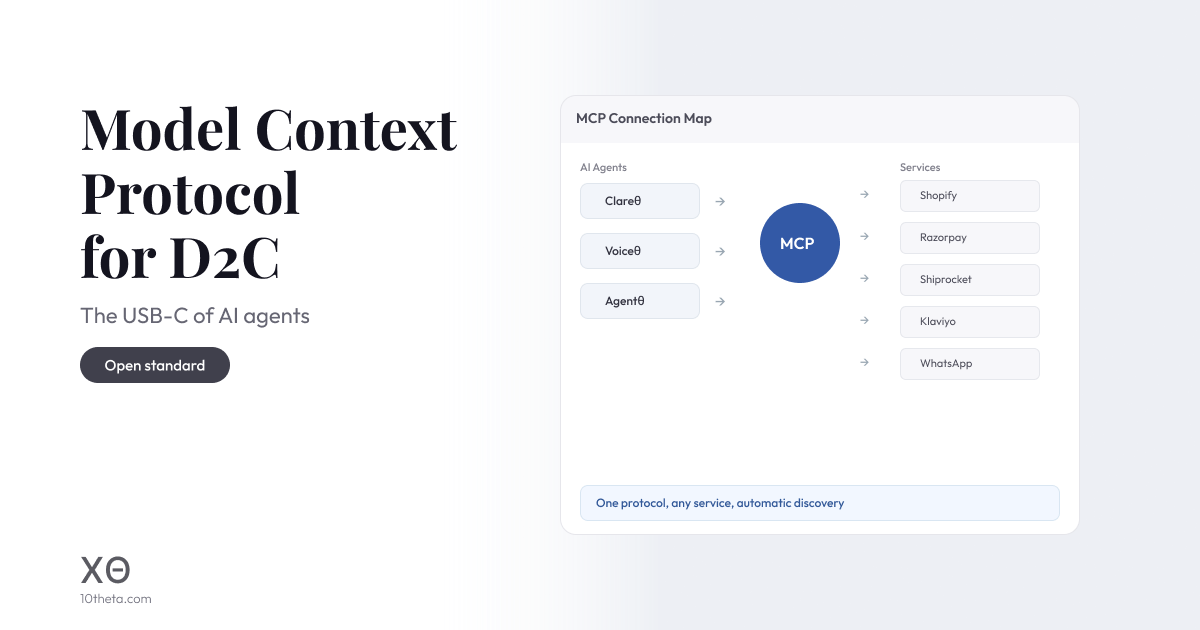
Model Context Protocol (MCP) is the open standard that lets AI agents connect to external services - Shopify stores, payment gateways, shipping providers, CRMs - through a single, universal interface. For D2C brands, MCP means your AI agents can check inventory, process payments, update orders, and pull customer data without custom API integrations for each service.
If you have been following the rise of AI agents in eCommerce, you have probably noticed a gap between what AI promises and what it actually delivers. An AI chatbot can answer product questions, but can it check whether that product is in stock right now? Can it process a refund? Can it look up where a customer's order is, in real-time, from your shipping provider?
The answer used to be "only if you build custom integrations for each service." MCP changes that. It is the protocol layer that turns AI agents from conversational toys into operational tools that actually do things inside your business.
What Is MCP?
Model Context Protocol is an open standard created by Anthropic that defines how AI models connect to external tools and data sources. Think of it as USB-C for AI - one universal connector instead of a different cable for every device.
Before MCP, connecting an AI agent to Shopify required custom code. Connecting to Razorpay required different custom code. Connecting to Shiprocket required yet more code. Each integration had its own authentication method, its own data format, its own error handling. Building and maintaining all of this was expensive and fragile - one API change could break the whole chain.
MCP standardizes this entirely. It defines a universal way for AI agents to discover what tools are available, understand what those tools can do, and call them with the right parameters. Any MCP-compatible AI agent can connect to any MCP-compatible service automatically. No custom code. No maintenance headaches. No breaking changes every time a provider updates their API.
Why D2C Brands Should Care
You do not need to understand the protocol itself. You need to understand what it enables for your business:
- Real-time inventory checks: Your AI shopping agent can verify product availability on Shopify before recommending it to a customer - no more "sorry, that's out of stock" after the customer has already decided to buy
- Cart recovery with context: Your cart recovery bot can pull the exact items a customer abandoned, their shipping address, and their payment preferences - then send a personalized WhatsApp message with a one-tap checkout link
- Payment troubleshooting: Your voice bot can access payment gateway status to understand why a transaction failed and guide the customer to a working payment method, in real-time during the call
- Order tracking: Your support agent can look up live tracking data from Delhivery or Shiprocket and give the customer an accurate delivery estimate without any human involvement
All of this happens without building custom integrations for each service. MCP makes AI agents actually useful instead of just conversational.
MCP vs Traditional API Integrations
The traditional approach to connecting AI agents with business tools looks like this: your engineering team builds a connector for each service, maintains it when APIs change, handles authentication separately for each provider, and writes custom error handling for every edge case. When you want to add a new tool or swap a provider, the cycle starts over.
With MCP, the model is fundamentally different. One protocol handles all connections. Services describe their own capabilities through MCP, so AI agents can automatically discover what tools are available and how to use them. Authentication is standardized. Error handling follows consistent patterns. When a provider updates their service, the MCP layer handles the change.
For D2C brands, the practical impact is significant:
- Faster deployment: Days instead of weeks to connect a new service
- Lower maintenance cost: No dedicated engineering time to keep integrations running
- Provider flexibility: Swap from one shipping provider to another without rebuilding your AI agents
- Reliability: Standardized protocol means fewer integration failures and better error recovery
How xθ Uses MCP
Agentθ is built on MCP from the ground up, which is why it offers 500+ integrations out of the box. When you build an AI agent in Agentθ, it can connect to any MCP-compatible service automatically - no code, no configuration files, no API key juggling.
Clareθ (AI shopping agent) uses MCP to access product catalogs, inventory levels, and customer profiles in real-time. When a shopper asks "Do you have this in size M?", Clareθ does not rely on a cached product feed from yesterday. It checks Shopify inventory right now, through MCP, and gives an accurate answer.
Voiceθ uses MCP to pull order status and payment data during live calls. When a customer calls about a delayed order, Voiceθ can look up tracking information from Shiprocket, check payment status from Razorpay, and provide a complete answer - all within the same conversation, without transferring to a human agent.
The key difference is that these are not pre-built, static integrations. They are live MCP connections that work with whatever tools you are already using. Switch from Razorpay to Cashfree? Your AI agents keep working. Add a new CRM? Your agents can access it immediately.
The D2C MCP Stack
Here is what a fully MCP-connected D2C operation looks like - every tool talking to every AI agent through one protocol:
- Shopify / WooCommerce (catalog, orders, inventory) via MCP
- Razorpay / Cashfree (payment status, refunds, subscriptions) via MCP
- Shiprocket / Delhivery (tracking, NDR management, delivery scheduling) via MCP
- Klaviyo / WebEngage (customer segments, campaign triggers, engagement data) via MCP
- WhatsApp Business API (messaging, notifications, conversational commerce) via MCP
In this setup, your AI agent does not exist in a silo. It has the same access to your business data that a well-trained human employee would have - but it can act on that data instantly, 24/7, across thousands of simultaneous conversations. A customer asks about a product, the agent checks inventory. They want to buy, the agent initiates payment. They need tracking, the agent pulls it from the shipping provider. One protocol connects everything.
Getting Started
You do not need to implement MCP yourself. Platforms like xθ handle the protocol layer entirely. What you should be asking when evaluating AI tools for your D2C business:
- Does your AI vendor support MCP? If they are building custom integrations for each service, you are locked into their roadmap and their maintenance schedule
- Can your agents access your tools in real-time? Cached data from hours ago is not good enough for inventory checks, payment status, or order tracking
- Can you swap providers without rebuilding? If changing your payment gateway means rebuilding your AI agent, the integration architecture is wrong
MCP is still early in adoption, but the direction is clear. The AI agents that will win in eCommerce are the ones that can actually interact with your business tools - not just chat with your customers. MCP is the protocol that makes that possible.
What is Model Context Protocol (MCP)?
MCP is an open standard created by Anthropic that lets AI agents connect to external tools and data sources through a universal interface. It works like USB-C for AI - one protocol to connect to any service, instead of building custom integrations for each tool.
Do I need to be technical to use MCP?
No. MCP is the underlying protocol - you interact with the AI agent, not the protocol. Platforms like xθ Agentθ handle MCP connections automatically. You just select which services to connect (Shopify, Razorpay, etc.) and the agent can access them.
Which eCommerce tools support MCP?
MCP adoption is growing rapidly. Major platforms including Shopify, payment gateways, and shipping providers are adding MCP support. xθ provides MCP connectors for 500+ tools, bridging services that do not have native MCP support yet.
Sources & References
- Anthropic - Model Context Protocol specification and documentation (https://modelcontextprotocol.io/)
- Shopify - AI and automation integrations for eCommerce (https://www.shopify.com/)
- xθ - Agentθ AI agent builder with MCP support (https://10theta.com/products/agent)
Related Articles
- AI Product Photography: Catalogue Without a Shoot
- Agentic Commerce: AI Agents in eCommerce
- AI Personalization for D2C eCommerce
- How to Reduce Cart Abandonment for D2C Brands
- Voice Bot for eCommerce in India
- 3 Hidden Data Patterns Every D2C Brand Should Track
Your AI agents should talk to your tools. Not just your customers.
Agentθ connects to 500+ services via MCP - build agents that check inventory, process payments, and update orders in real-time.
Build Your First Agent or calculate your revenue leaks for free ›