AI Voice Bot for D2C eCommerce India: Cart Recovery, COD Confirmation & Beyond (2026)
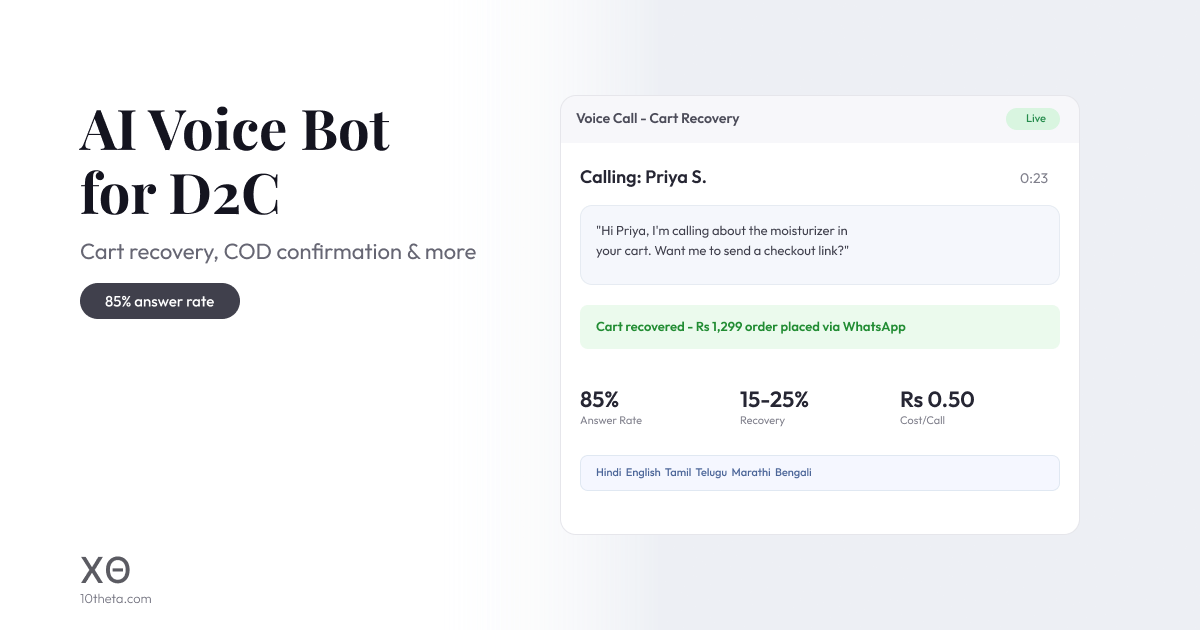
AI voice bots recover 15-25% of abandoned carts by calling shoppers within 30 minutes of abandonment, and reduce RTO by 25-40% through automated COD order confirmation - at Rs 0.50-1.50 per call versus Rs 200-400 per failed delivery. For Indian D2C brands, voice AI is the highest-ROI automation channel that most brands haven't deployed yet.
1. Why Voice Beats Email and SMS for D2C
The numbers tell a clear story. Email open rate: 15%. SMS open rate: 45%. Phone answer rate: 85%. Voice is the most personal, highest-engagement channel available to D2C brands today. When a customer sees an incoming call, they pick up. When they see an email, they scroll past.
In India, where 75%+ of shoppers are mobile-first and many prefer voice over text, AI voice bots have a natural advantage. Rural and semi-urban customers - who represent the fastest-growing eCommerce segment - are significantly more comfortable with voice interactions than typed messages or app notifications.
The economics have shifted dramatically. Neural voice synthesis has dropped the cost per AI call to Rs 0.50-1.50 - making it viable even for brands with average order values under Rs 500. Compare that to the Rs 5-8 cost of an SMS or the Rs 200-400 cost of a single RTO. Voice isn't just more effective - it's cheaper per conversion than every other channel.
2. Cart Recovery Calls
When a shopper abandons their cart, timing is everything. An AI voice bot calls within 30 minutes of abandonment - while the purchase intent is still fresh. "Hi Priya, I'm calling about the moisturizer in your cart. Would you like me to send a checkout link to your WhatsApp?"
If the shopper has objections - price concerns, shipping time questions, product doubts - the AI handles them in real-time. "I can apply a 10% discount code right now" or "That product ships within 24 hours from our Mumbai warehouse." The conversation feels natural, not scripted, because modern voice AI understands context and responds dynamically.
The results speak for themselves: 15-25% cart recovery rate versus 5-8% for email. The call costs Rs 0.50. The recovered order is worth Rs 1,000+. For a brand with 500 abandoned carts per day, that translates to 75-125 additional recovered orders daily - revenue that would have been lost to a follow-up email sitting unread in a promotions tab.
3. COD Order Confirmation
This is the single highest-impact use case for RTO reduction. When a COD order is placed, an AI call goes out within minutes: "Press 1 to confirm your order of Rs 1,299 to 400001 Mumbai. Press 2 to cancel." The entire call takes 15-20 seconds.
Non-responsive customers - those who don't answer after 2-3 attempts or refuse to confirm - get flagged for manual review or automatic cancellation. Confirmed orders proceed to fulfillment with confidence. This simple filter catches impulse purchases, fake orders, and address mismatches before they become expensive RTOs.
Result: 25-40% RTO reduction. Cost per call: Rs 0.50. Cost per prevented RTO: Rs 200-400. The ROI is immediate and measurable. A brand processing 5,000 COD orders per month with a 30% RTO rate saves Rs 3-6 lakh monthly by preventing just half of those RTOs through voice confirmation.
4. Failed Payment Recovery
When a payment fails at checkout, most stores show a generic "Try again" page. The problem is that 60-70% of customers don't try again. They leave, and that revenue disappears. An AI voice bot changes this by calling within 2 minutes of the failure.
"Hi, your card payment of Rs 2,499 didn't go through. I can send you a UPI payment link right now - it takes 10 seconds to complete. Should I send it to your WhatsApp?" The immediacy matters. The customer is still at their phone, still in buying mode. A quick UPI link removes all friction.
This approach recovers 30-40% of failed transactions that would otherwise be lost forever. For brands processing 1,000+ transactions daily with a 15-20% payment failure rate, that's 45-80 additional successful orders per day - purely from a 30-second automated call. Combined with Payθ's intelligent payment retry logic, failed payment recovery becomes a significant revenue channel.
5. Multi-Language Voice AI for India
India has 22 official languages. Your customers speak Hindi, Tamil, Telugu, Marathi, Bengali, Kannada, Malayalam, and more. A single-language approach misses the majority of your addressable market. Modern AI voice bots auto-detect the customer's language from their first response and switch seamlessly.
This isn't robotic IVR with "Press 1 for Hindi, Press 2 for English." This is conversational AI that understands context, handles interruptions, adjusts tone based on sentiment, and responds naturally in the customer's preferred language. When a Tamil-speaking customer in Chennai receives a cart recovery call, the AI speaks Tamil - not stilted, translated Tamil, but natural conversational Tamil.
The impact on conversion is dramatic. Customers who interact in their native language are 72% more likely to complete a purchase. For D2C brands expanding beyond metro cities into Tier 2 and Tier 3 markets, multi-language voice AI isn't optional - it's the difference between a 5% and 25% recovery rate in those regions.
6. Inbound Support Automation
"Where is my order?" - this single question accounts for 40-60% of all customer support queries for D2C brands. An AI voice bot pulls live tracking data from your shipping provider and answers in seconds. No hold times, no ticket queues, no agent bandwidth wasted on repetitive queries.
Beyond order tracking, voice AI handles returns (checks eligibility against your policy, generates return labels, schedules pickup), product questions (answers from your catalog data - sizes, materials, compatibility), and complaints (first-level acknowledgment with human escalation for complex issues).
The cost math is compelling. A human support agent handles 40-50 calls per day at a cost of Rs 15,000-25,000 per month. An AI voice bot handles 5,000+ calls per day at Rs 0.50-1.50 per call. For brands receiving 200+ support calls daily, voice AI reduces support costs by 60-80% while improving response times from minutes to seconds.
7. Smart Timing and Compliance
When you call matters as much as what you say. AI picks optimal call timing based on customer behavior patterns. If a customer typically browses your store at 8 PM, the cart recovery call goes out at 8:15 PM - not at 10 AM when they're in a meeting.
Compliance is non-negotiable. All calls operate within TRAI-compliant hours (9 AM - 9 PM). The system respects DND (Do Not Disturb) registrations automatically. Every call provides a clear opt-out option. Every call is recorded and transcribed for audit trails - protecting both the brand and the customer.
Sentiment detection adds another layer of intelligence. If the AI detects frustration, anger, or confusion in the customer's voice, it auto-escalates to a human agent within seconds. No customer gets stuck in an AI loop when they need a real person. This combination of smart timing, regulatory compliance, and sentiment-aware escalation ensures voice AI enhances the customer experience rather than degrading it.
8. How Voiceθ Works
Getting started with voice AI doesn't require months of integration work. Connect your Shopify or WooCommerce store to Voiceθ, set your triggers (cart abandoned, COD order placed, payment failed, delivery attempt failed), and Voiceθ handles the calls automatically.
The real-time dashboard shows call recordings, full transcripts, recovery rates, and revenue impact - broken down by trigger type, language, time of day, and customer segment. You see exactly which calls converted and why, so you can continuously optimize your scripts and timing.
Voiceθ integrates with Exotel, Twilio, and Knowlarity for telephony infrastructure, so you use your existing phone numbers and telecom setup. No new hardware, no separate phone system. The AI handles the conversation - your existing telephony provider handles the connectivity.
How much does an AI voice bot cost per call for D2C brands?
AI voice bot calls cost Rs 0.50-1.50 per call in India, depending on duration and language. Compare this to the Rs 200-400 cost of an RTO or the Rs 1,000+ value of a recovered cart. Most D2C brands see 10-20x ROI within the first month.
Can AI voice bots speak Hindi and regional languages?
Yes. Modern AI voice bots support Hindi, English, Tamil, Telugu, Marathi, Bengali, and more. They auto-detect the customer's language and respond naturally with conversational AI - not robotic IVR menus.
Is it legal for D2C brands to auto-call customers in India?
Yes, when calling customers with an existing relationship (placed an order, abandoned a cart). Calls must comply with TRAI regulations - only during 9 AM to 9 PM, respecting DND registrations, and providing opt-out options.
What is the cart recovery rate with AI voice bots?
AI voice bots recover 15-25% of abandoned carts when calling within 30 minutes of abandonment. This is 2-3x higher than email recovery (5-8%) because phone answer rates (85%) are dramatically higher than email open rates (15%).
Sources & References
- TRAI - Telecom Regulatory Authority of India, calling hours and DND compliance regulations
- Baymard Institute - Cart abandonment rate statistics and recovery benchmarks (https://baymard.com/)
- Exotel - AI voice bot platform for Indian businesses, call cost benchmarks (https://exotel.com/)
Related Articles
- How to Reduce Cart Abandonment for D2C Brands
- How to Reduce RTO in eCommerce India
- COD to Prepaid Conversion: Strategies for Indian D2C
- Payment Success Rate Optimization for D2C
- WhatsApp Commerce for D2C Brands in India
Your team makes 50 calls a day. Voiceθ makes 5,000.
AI voice calls that recover carts, confirm orders, and handle support - in 6 languages, 24/7, at Rs 0.50 per call.
Start Calling or calculate your voice bot ROI for free ›