How to Reduce RTO in eCommerce India: 8 Proven Strategies for 2026
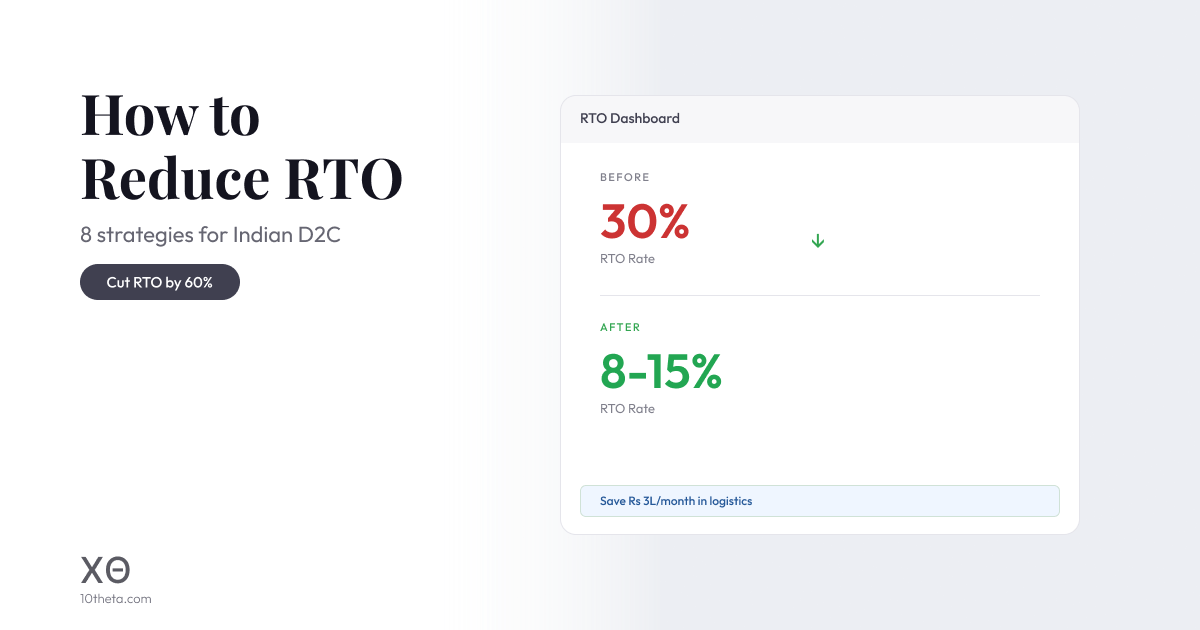
India's eCommerce RTO (Return to Origin) rate averages 25-35%, compared to the global benchmark of 8-12%. Each failed delivery costs D2C brands ₹100-150 in wasted logistics, and COD orders drive 80% of all RTOs - but data-backed strategies can reduce RTO to 8-15% within months.
Return to Origin is the silent profit killer of Indian eCommerce. While the global average RTO rate sits at 8-12%, Indian D2C brands face rates of 25-35% - and for brands heavily reliant on Cash on Delivery, that number can spike above 40%. Each returned order costs ₹100-300 in combined forward shipping, reverse logistics, packaging, and inventory holding costs. For a brand doing 10,000 orders per month with a 30% RTO rate, that translates to ₹3-9 lakh in monthly losses from RTOs alone.
The good news: RTO is largely preventable. The brands winning in 2026 are using a combination of payment strategies, address intelligence, AI risk scoring, and customer verification to bring RTO rates below 10%. Here are eight proven strategies that work.
1. COD-to-Prepaid Conversion
This is the single highest-impact RTO reduction strategy. Prepaid orders carry RTO rates of just 3-5%, compared to 25-40% for COD. The reason is straightforward: a customer who has already paid has committed financially and is far less likely to refuse delivery.
Effective COD-to-prepaid nudges include offering a ₹50-100 discount for prepaid payment, prominently displaying UPI and wallet options before COD, and showing estimated delivery date advantages for prepaid orders (e.g., "Pay now, get it 1 day faster"). Payθ automates this with intelligent payment method ordering - if a returning customer's UPI success rate is high, UPI is shown first with a prepaid incentive. Brands using smart COD-to-prepaid nudges convert 20-35% of COD orders to prepaid, reducing overall RTO by 15-25%.
Engageθ2. WhatsApp COD Confirmation
After a COD order is placed, an automated WhatsApp message asks the customer to confirm their order details - name, address, product, and delivery preference. This serves three purposes: verifying genuine purchase intent, catching address errors before shipping, and offering one more opportunity to convert to prepaid ("Confirm and save ₹50 - pay now via UPI").
Brands implementing WhatsApp COD confirmation report 30-40% RTO reduction on confirmed orders. Non-responsive orders can be flagged for manual verification or deprioritized in fulfillment. Combined with Skillθ's automated WhatsApp flows, the entire confirmation process runs without manual intervention.
3. Address Verification and Standardization
Bad addresses account for 25-30% of all RTOs in India. Incomplete pin codes, missing landmarks, incorrect flat numbers, and ambiguous locality names cause delivery failures even when the customer genuinely wants the product. Address verification at checkout catches these errors before the order ships.
Implement real-time pin code validation, auto-suggest addresses from a verified database, and flag orders with previously failed delivery addresses. Address prefill using a shopper network (GoKwik claims 200M+ addresses, Shopflo 50M+) eliminates manual entry errors for returning customers. xθ's Secureθ Identityθ maintains verified address profiles that improve with each successful delivery, reducing address-related RTOs to near zero for repeat customers.
4. AI-Powered RTO Risk Scoring
Not all orders carry equal RTO risk. AI models analyze historical data - customer's past RTO history, order value, payment method, address quality, time of order, and product category - to assign a risk score to each order. High-risk orders can be routed through additional verification steps or restricted to prepaid-only checkout.
Key risk signals include: first-time customers ordering via COD (highest RTO risk), orders placed between midnight and 5 AM, multiple orders to the same address in a short period, and addresses in pin codes with historically high RTO rates. Brands using AI risk scoring reduce RTO by 30-50% on flagged orders. One Mumbai retailer reported cutting overall RTO from 22% to 13% after implementing AI-driven risk assessment.
5. IVR Order Confirmation
For high-value COD orders or orders flagged as medium-risk by AI scoring, automated IVR (Interactive Voice Response) calls provide an additional verification layer. The system calls the customer within minutes of order placement, asking them to confirm the order by pressing 1. Orders that go unconfirmed after 2-3 attempts are automatically cancelled or converted to a pending state.
IVR confirmation is most effective for orders above ₹1,500 and first-time COD customers. The cost per IVR call (₹0.50-1.00) is negligible compared to the ₹100-300 cost of an RTO. Brands combining IVR with WhatsApp confirmation see the lowest overall RTO rates - typically 8-12%, approaching the global benchmark.
6. Smart COD Eligibility
Not every customer or product should be eligible for COD. Implementing dynamic COD eligibility rules based on risk factors dramatically reduces RTO without eliminating COD entirely - which would hurt conversion rates for new customer acquisition.
Effective COD rules include: restrict COD for first-time customers ordering above ₹3,000, disable COD for pin codes with >40% historical RTO rate, require partial advance payment (₹99) for high-value COD orders, and block COD for customers with 2+ previous RTOs. These rules can be managed through Payθ, which dynamically adjusts COD eligibility at checkout based on real-time risk assessment.
7. Accurate Product Descriptions and Images
A surprisingly large percentage of RTOs stem from product-expectation mismatch - the customer receives a product that looks different from what they expected. This is especially common in fashion (color mismatch, fabric quality), electronics (feature gaps), and beauty (shade differences).
Reduce expectation-driven RTOs by using multiple high-quality product images from different angles, including video content showing the product in use, displaying accurate size charts with measurement guides, showing realistic color representations (not over-saturated), and including customer review photos. Clareθ helps by answering product questions in real-time - when a shopper asks "Is this dress true to size?" or "What does this shade look like on medium skin?", AI provides accurate, personalized answers that reduce post-purchase disappointment.
8. NDR (Non-Delivery Report) Management
When a delivery attempt fails, the clock starts ticking. Every hour that passes without re-engagement reduces the probability of successful re-delivery. Automated NDR management immediately contacts the customer via WhatsApp when a delivery fails, asking them to confirm availability and provide updated instructions.
"Hi, we tried to deliver your order today but couldn't reach you. When would you like us to redeliver? Reply 1 for tomorrow morning, 2 for tomorrow evening, 3 for a different address." This simple WhatsApp flow recovers 40-60% of failed first-attempt deliveries, converting what would have been RTOs into successful orders.
The ROI of RTO Reduction
Consider a D2C brand processing 10,000 orders/month at ₹1,500 average order value with a 30% RTO rate:
- Current RTO cost: 3,000 RTOs × ₹200 avg cost = ₹6 lakh/month
- After reducing RTO to 15%: 1,500 RTOs × ₹200 = ₹3 lakh/month
- Monthly savings: ₹3 lakh + recovered revenue from 1,500 additional successful deliveries
- Annual impact: ₹36 lakh in savings + ₹2.7 crore in recovered revenue
The investment required - AI risk scoring, WhatsApp automation, and smart checkout tools - typically pays for itself within the first month.
What is a good RTO rate in India for ecommerce?
A good RTO rate for Indian ecommerce is below 10%. The industry average for COD-heavy D2C brands is 25-35%, while the global benchmark is 8-12%. Brands implementing AI risk scoring, WhatsApp COD confirmation, and smart prepaid nudges can achieve 8-15% RTO rates within 2-3 months.
How much does RTO cost per order in India?
Each RTO costs Indian D2C brands ₹200-400 per order, combining forward shipping (₹60-80), reverse logistics (₹60-80), packaging (₹20-30), and inventory holding costs. For a brand doing 10,000 orders/month with a 30% RTO rate, this translates to ₹6-12 lakh per month in RTO-related losses.
Sources & References
- RedSeer Consulting - Indian eCommerce logistics and RTO benchmarks, 25-35% average RTO rate for Indian D2C brands
- Unicommerce - eCommerce logistics report India, COD vs prepaid RTO rate comparison (https://unicommerce.com/)
- NPCI - UPI adoption and prepaid payment success rates driving RTO reduction (https://www.npci.org.in/what-we-do/upi/product-statistics)
Related Articles
- Switching Checkout Providers and RTO Liability
- D2C Checkout Optimization Guide
- COD to Prepaid Conversion: Strategies for Indian D2C
- WhatsApp Commerce for D2C Brands: Complete Guide
- How to Reduce Cart Abandonment for D2C Brands
- AI Voice Bot for D2C: Cart Recovery, COD Confirmation & Beyond
Every RTO costs you ₹200-400. How many did you have this month?
xθ reduces RTO with COD-to-prepaid conversion, AI risk scoring, and WhatsApp order confirmation - catching bad orders before they ship.
See How xθ Reduces RTO or calculate your revenue leaks for free ›