COD to Prepaid Conversion: 5 Strategies for Indian D2C Brands
COD orders account for 60-75% of Indian D2C transactions but carry a 28-35% RTO rate versus just 4-8% for prepaid - costing brands ₹180-240 per failed delivery. Converting even 20-30% of COD to prepaid can cut logistics costs by 15-25% while improving cash flow.
Cash on delivery has been the backbone of Indian eCommerce for over a decade. It built buyer trust in an era when online payments felt risky and unfamiliar. But in 2026, COD has become one of the biggest margin killers for D2C brands. While it still accounts for 40-55% of orders for many Indian D2C businesses, the hidden costs of COD are eroding profitability in ways that many founders underestimate.
The good news is that the Indian payment landscape has changed dramatically. UPI processes over 14 billion transactions monthly, digital wallets are mainstream, and consumer trust in online payments has never been higher. The opportunity to shift your order mix from COD to prepaid is real, and the strategies below will help you do it without losing sales volume.
The COD Problem: Why Indian D2C Brands Lose Margins
On the surface, COD seems like a customer-friendly option that should increase conversions. And it does increase order volume. But the orders it adds come with significant costs that eat into your bottom line. The core issue is that COD creates a commitment gap. When a shopper places a COD order, they have not actually spent any money. They have made a low-commitment decision that they can reverse simply by refusing delivery. This fundamentally changes the economics of each order.
The True Cost of COD
The most visible cost is Return to Origin (RTO). COD orders have RTO rates of 25-40% compared to just 5-10% for prepaid orders. Every RTO means you have paid for forward shipping, attempted delivery, and return shipping, all for zero revenue. For a brand shipping 1,000 COD orders per month with a 30% RTO rate, that is 300 orders where you absorb the full logistics cost with nothing to show for it.
Then there is cash handling. COD remittance from logistics partners typically takes 7-14 days after delivery, compared to instant settlement for prepaid payments. This cash flow delay forces brands to maintain higher working capital, often funded through debt. The remittance itself also incurs a COD handling fee of Rs 30-60 per order, charged by the logistics partner.
Finally, delayed revenue recognition creates planning challenges. You cannot accurately forecast revenue when 40% of your orders might not convert to actual sales. Marketing spend optimization becomes difficult because your true cost of acquisition is obscured by RTO losses.
COD vs Prepaid: The Numbers
1. Prepaid Discounts (5-10% Off)
The simplest and most widely effective strategy is offering a direct financial incentive for paying upfront. A 5-10% discount for prepaid orders is immediately understandable to shoppers and gives them a clear reason to choose prepaid over COD. The key is making the math work. If your average order value is Rs 1,200 and you offer an 8% prepaid discount (Rs 96), you are giving up Rs 96 in margin per order. But a COD order at the same value costs you Rs 40-60 in handling fees plus the risk of a 30% RTO rate, which at a Rs 150 average shipping cost per failed delivery, adds Rs 45 in expected RTO cost per COD order. The prepaid discount effectively costs you the same or less while dramatically improving your cash flow and reducing operational complexity.
Display the prepaid discount prominently on the product page, in the cart, and especially on the checkout page. Frame it as a savings message rather than a penalty for COD. "Save Rs 96 with prepaid payment" works much better psychologically than "Rs 96 extra for COD." Use Cartθ to dynamically show the prepaid savings amount in the cart drawer, making it visible throughout the shopping experience.
2. UPI Payment Optimization
UPI has fundamentally changed online payments in India, but many D2C brands have not optimized their checkout for UPI-first behavior. If your checkout flow still defaults to cards or wallets with UPI buried as a secondary option, you are missing the single biggest opportunity to increase prepaid adoption.
Start by making UPI the first and most prominent payment option at checkout. Show familiar UPI app logos (Google Pay, PhonePe, Paytm) to build recognition and trust. Implement UPI intent flow, which opens the customer's UPI app directly rather than requiring them to type a VPA, reducing friction to a single tap. Enable UPI QR code display for desktop shoppers who want to scan with their phone. With Payθ, these optimizations happen automatically. Payθ intelligently detects the customer's device, location, and past payment preferences to present the optimal UPI flow for each individual checkout. Brands using Payθ see UPI success rates improve by 12-18% compared to default payment gateway configurations.
Engageθ3. Trust Signals: Reviews, Certifications, and Social Proof
Many shoppers choose COD not because they prefer it, but because they do not fully trust the brand yet. They worry about product quality, whether the item will match the photos, and whether returns will be honored. COD is their insurance policy against a bad experience. If you can address these trust concerns before checkout, many of these shoppers will willingly pay upfront.
Place customer reviews with photos prominently on product pages and in the cart. Show the total number of orders fulfilled or customers served as social proof. Display any certifications, awards, or press mentions near the checkout button. Include a clear, concise return policy summary directly on the checkout page, not hidden in a footer link. Show estimated delivery dates with courier partner logos to make the delivery feel tangible and trustworthy. Brands that implement comprehensive trust signals at checkout typically see a 10-15% shift from COD to prepaid within the first month, simply by removing the uncertainty that drives COD selection.
4. Partial COD: Pay a Small Amount Upfront
Partial COD is a relatively new strategy that bridges the gap between full prepaid and full COD. The concept is simple: the customer pays a small amount (Rs 50-100) online at checkout and pays the remaining balance on delivery. This small upfront payment creates just enough financial commitment to dramatically reduce frivolous orders and RTO rates.
The psychology is powerful. A customer who has already invested Rs 100 is far more committed to accepting the delivery than one who has paid nothing. Brands implementing partial COD report RTO rates dropping from 30-35% to 12-18%, which is a massive improvement. The key is positioning it correctly. Frame it as "Pay Rs 99 now, rest on delivery" rather than "Partial COD." The language should make it feel like a convenience feature rather than a trust issue. Some brands position the upfront amount as a "booking fee" or "order confirmation charge," which shoppers accept naturally.
5. Smart Nudges with Payθ
Payθ takes COD-to-prepaid conversion beyond static discounts and manual configurations. It uses AI to analyze each customer's payment behavior, order history, and risk profile to dynamically nudge them toward prepaid at the optimal moment and with the right incentive.
For a returning customer who has successfully received two previous orders, Payθ might show a subtle message: "Your last 2 orders were delivered perfectly. Pay online and save Rs 75." For a first-time customer from a high-RTO pincode, it might offer a stronger incentive or suggest partial COD. For a customer who always pays via UPI, it highlights the one-tap UPI option before even showing COD. This intelligence means your conversion strategy adapts to each customer rather than applying a blanket policy. Payθ also integrates with Insightθ to give you clear visibility into your COD-to-prepaid ratio trends, pincode-level RTO analysis, and the ROI of each conversion strategy.
Before and After: What the Shift Looks Like
Before Optimization
After 90 Days with xθ
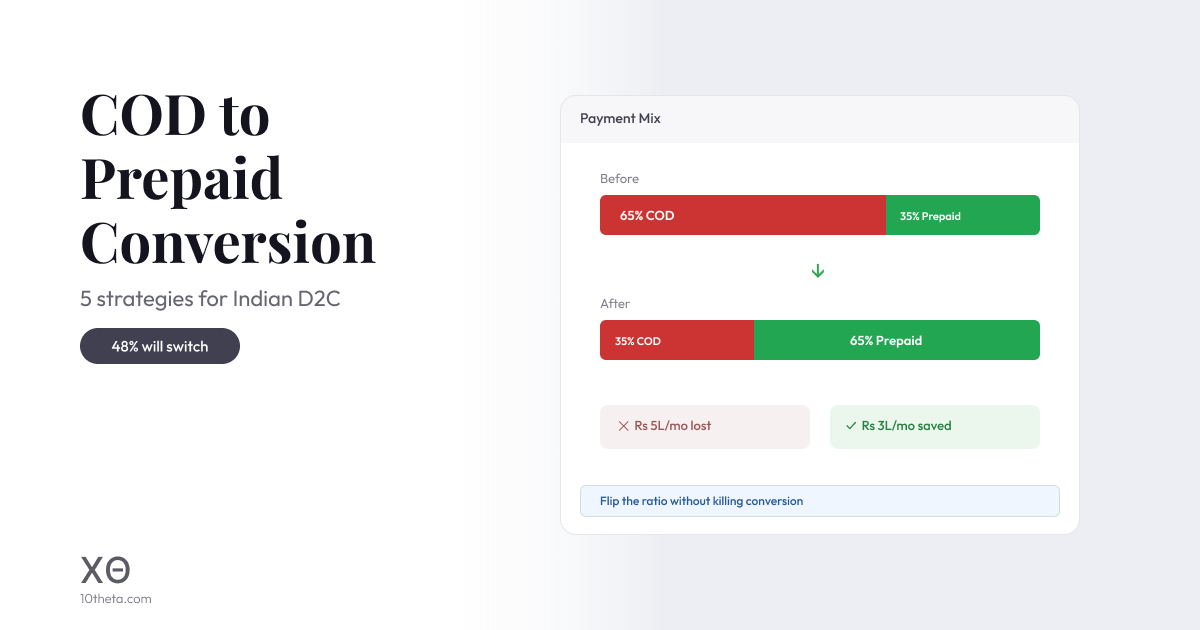
The combined effect of these five strategies typically results in a 20-30 percentage point shift from COD to prepaid within 90 days. For a brand doing Rs 50 lakh in monthly GMV, this translates to Rs 2-4 lakh in monthly savings from reduced RTO losses, lower handling fees, and improved cash flow. The savings compound as the prepaid ratio improves, because better cash flow enables more aggressive marketing investment, which drives further growth.
What is the COD rejection rate in India?
The COD rejection rate in India averages 28-35% for D2C brands, compared to just 4-8% for prepaid orders. COD orders account for 60-75% of Indian D2C transactions, and each rejected COD order costs brands ₹180-240 in wasted logistics. About 48% of COD users are willing to switch to prepaid when offered the right incentive.
Sources & References
- RedSeer Consulting - Cash-on-delivery trends in Indian eCommerce, 60-75% COD share across D2C brands
- Razorpay - Digital payments in India report, prepaid adoption trends and UPI growth statistics (https://razorpay.com/)
- Pragma - COD-to-prepaid conversion benchmarks, 25-35% improvement with smart payment nudges (https://www.gopragma.com/)
Related Articles
- Switching Checkout Providers: What to Check First
- How to Reduce RTO in eCommerce India
- One-Click Checkout Comparison India 2026
- WhatsApp Commerce for D2C Brands: Complete Guide
- AI Voice Bot for D2C: Cart Recovery, COD Confirmation & Beyond
- Best Payment Gateways in India: Razorpay vs Cashfree vs PayU
Every COD order costs you 3-5x more in RTO than prepaid.
Payθ converts 20-35% of COD shoppers to prepaid at checkout - with smart discounts, trust signals, and one-tap UPI. No manual setup.
See How Payθ Converts COD or calculate your revenue leaks for free ›