Switching D2C Checkout Providers: What Actually Breaks
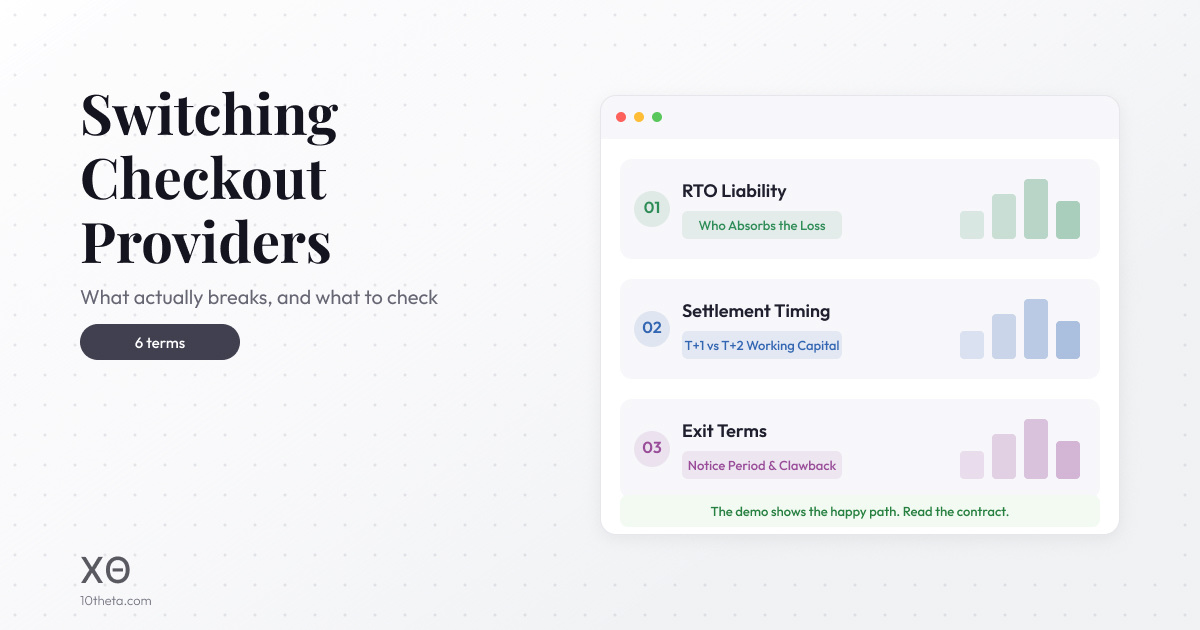
Most D2C brands evaluate a checkout provider on the demo: the conversion lift, the one-tap flow, the dashboard. The terms that actually determine whether the switch was worth it are RTO liability, settlement timing, customer data ownership, and exit conditions. None of those appear in a demo, and all of them are hard to renegotiate after you sign.
Switching checkout is one of the most common infrastructure decisions in Indian D2C, and one of the least examined. The comparison usually happens on features, because features are what vendors present. The costs show up later, in reconciliation, in the RTO line, and in what it takes to leave.
This is the checklist worth running before you sign, written from the questions brands wish they had asked earlier.
Why Brands Switch in the First Place
The trigger is rarely the feature set. In practice it is one of four things:
- RTO is eating the margin: COD-heavy brands discover their checkout provider scores risk but does not absorb it, so the loss stays on their books
- The rate stopped making sense at scale: pricing that was reasonable at ₹50 lakh monthly GMV is a large line item at ₹5 crore, and GMV-based pricing scales with you whether or not the value does
- Payment success plateaued: single-gateway routing caps success rates, and the gap between a good and bad routing layer widens as volume grows
- Support stopped scaling: the response time that was fine during onboarding is not fine during a festive sale
All four are legitimate reasons to move. The problem is that brands then evaluate the replacement on the same axis that made them unhappy, and miss the terms that create the next set of problems.
What the Demo Shows vs What You Find in Month Two
A checkout demo is optimised to show the happy path: a returning customer, a working payment method, a prefilled address, a one-tap purchase. That flow is real, and it is also the least interesting part of the system.
What you find later lives in the edges. What happens when the UPI intent fails and the customer retries on a different app. Who is charged when a COD order is refused at the door. When money actually lands in your account relative to when the order was placed. What your reconciliation looks like when partial refunds and cancellations are in the same settlement cycle. None of that is visible in a thirty-minute call.
Six Things to Check Before You Sign
1. RTO liability: scoring or absorbing?
This is the most expensive ambiguity in the category. Some providers offer RTO guarantees and take a share of the loss. Others provide risk scoring and address verification, which reduces RTO but leaves every rupee of it with you. Both are defensible products. They are not the same product, and the pricing difference between them should reflect that.
Ask directly: if an order your system approved is refused at the door, who pays for the forward and reverse leg? Get the answer in the contract, not in the pitch. For COD-heavy brands this single term often outweighs every feature on the comparison grid.
2. Settlement timing and working capital
T+1 and T+2 sound like a minor operational difference until you model it against your ad spend. If you are reinvesting revenue into acquisition daily, an extra day of settlement is an extra day of working capital you have to fund yourself. Check the standard cycle, what triggers a hold, and how disputes and partial refunds affect timing.
3. Who owns the customer data
Checkout sits on your most valuable first-party data: addresses, payment preferences, purchase intent. Establish whether that data is yours to export in full, in what format, and whether the provider retains rights to use it across their network. Shopper networks that prefill addresses across brands are genuinely useful, and they also mean your data is part of a shared asset. That may be a fair trade. Make it knowingly.
4. Your real conversion baseline
You cannot evaluate the switch without knowing what you are comparing against. Establish a four-week baseline before migration: conversion by device, by payment method, by new versus returning, and by traffic source. Without it, every post-migration number is an argument rather than a measurement, and seasonality will let both sides claim they were right.
5. Payment routing depth
Single-gateway checkout caps your success rate at that gateway's performance. Multi-gateway routing selects per transaction based on success-rate history, which is where the meaningful gains are once you are past basic UX fixes. Ask how many gateways are supported, whether routing is rule-based or learned, and whether you can add your own gateway relationships.
6. Exit terms
Read this section first, not last. What is the notice period, what happens to saved customer credentials when you leave, can you export tokenised payment data or does every returning customer have to re-enter their card, and is there a minimum commitment or GMV clawback. A provider confident in the product will have reasonable exit terms. Difficulty here is itself a signal.
How to Run the Migration
The sequence matters more than the timeline:
- Baseline first: four weeks of clean conversion data before anything changes
- Run parallel: route a slice of traffic to the new checkout rather than cutting over fully, so you compare on the same days against the same campaigns
- Migrate credentials early: saved addresses and payment preferences are the biggest source of post-switch conversion loss, so test that path before the cutover, not after
- Test the failure paths: failed UPI intent, expired card, COD refusal, partial refund. The happy path already works, that is why it was in the demo
- Wait one full settlement cycle: do not decommission the old provider until you have reconciled a complete cycle on the new one
- Never migrate into a peak: festive season is the worst possible time to discover an edge case
For a feature-level view of the main platforms, our one-click checkout comparison covers GoKwik, Shopflo, Shiprocket Fastrr, and Payθ side by side.
What Switching Cannot Fix
Worth being honest about the limits, because checkout gets blamed for problems that live elsewhere:
- A weak product or unclear pricing: if customers hesitate on value, a faster checkout moves the hesitation earlier rather than removing it
- Traffic quality: checkout converts intent that already exists. It does not create intent that acquisition failed to buy
- Structural COD preference: better checkout shifts the prepaid ratio at the margin, it does not change a category where customers fundamentally prefer paying at the door
- Delivery experience: RTO caused by slow or unreliable delivery is a logistics problem showing up in the checkout report
If your diagnosis is that checkout is the constraint, switching is worth doing properly. If checkout is where the problem is visible rather than where it originates, a migration costs you weeks and changes little.
How long does a checkout migration actually take?
Plan for two to four weeks end to end, most of which is not engineering. The integration itself is usually days. What consumes the time is running both checkouts in parallel to establish a clean conversion baseline, migrating saved addresses and payment preferences, re-testing every payment method including COD and UPI intent, and waiting out one full settlement cycle to confirm reconciliation matches. Brands that skip the parallel run are the ones who cannot tell afterwards whether the new provider helped or hurt.
Will I lose conversion when I switch?
Usually yes, temporarily. Returning customers lose saved addresses and payment credentials unless those migrate cleanly, and that alone can dent conversion for the first few weeks. The mistake is comparing your first post-migration week against your best pre-migration week. Measure a four-week baseline before you cut over and compare like periods, including the same position in your discount and campaign calendar.
Who is liable for RTO after a switch?
This varies significantly by provider and by contract, and it is the single term most worth reading closely. Some checkout platforms offer RTO guarantees or share the loss; others only provide risk scoring and leave the cost with you. The distinction matters most for brands with high COD ratios, where RTO is often the largest single leak. Ask for the liability terms in writing before signing rather than relying on what the demo implies.
Sources & References
- xθ - one-click checkout platform comparison for India (https://10theta.com/blog/one-click-checkout-comparison-india)
- xθ - Payθ smart checkout and multi-gateway routing (https://10theta.com/products/pay)
- Reserve Bank of India - guidelines on payment aggregators and settlement (https://www.rbi.org.in/)
Related Articles
- One-Click Checkout Comparison India 2026
- Payment Success Rate Optimization for D2C Brands
- How to Reduce RTO in eCommerce India
- COD to Prepaid Conversion Strategies
- D2C Unit Economics India
Checkout should not cost you a migration to evaluate.
Payθ routes every transaction to the gateway most likely to succeed, with COD-to-prepaid nudges and one-click checkout built in.
See Payθ On Your Store or calculate your revenue leaks for free ›