Payment Success Rate Optimization for D2C Brands in India (2026)
15-20% of Indian eCommerce orders fail at payment - not abandoned, failed. Smart payment routing, UPI-first checkout, and automatic gateway failover can push success rates above 95%, recovering lakhs in revenue that most D2C brands don't even know they're losing.
There is a critical difference between cart abandonment and payment failure. Cart abandonment happens when a customer decides not to buy. Payment failure happens when a customer tries to pay and the system breaks. The first is a marketing problem. The second is an infrastructure problem - and in India, it is far more common than most brands realize.
Globally, payment failure rates hover around 3-5%. In India, the number is 15-20%. That means for every 100 customers who click "Pay Now," 15-20 of them hit an error, a timeout, or a blank screen. They wanted to give you their money, and your checkout refused to take it. Most of them will not try again.
1. The Hidden Revenue Leak
Payment failures are the most underreported revenue leak in Indian eCommerce. Unlike cart abandonment, which shows up clearly in analytics dashboards, payment failures often hide in gateway logs that nobody checks. The customer intended to pay, attempted to pay, and was turned away by a technical failure - not a change of mind.
The root causes are well-documented: gateway downtime during peak traffic (festival sales, flash deals), bank OTP delays that cause session timeouts, netbanking redirects that break on mobile browsers, and single-gateway dependency that means one provider's outage takes down 100% of your transactions. Card payments in India require 3DS authentication with OTP, adding a failure-prone step that doesn't exist in markets like the US.
Let's do the math. A D2C brand processing 10,000 orders per month with an average order value of ₹1,500 and a 15% payment failure rate loses 1,500 orders every month. That is ₹22.5 lakh in revenue - not from customers who weren't interested, but from customers who were actively trying to pay. Over a year, that compounds to ₹2.7 crore in lost revenue. For most D2C brands operating on 15-25% margins, this is the difference between profitability and loss.
2. Why UPI Should Be Your Default Payment Method
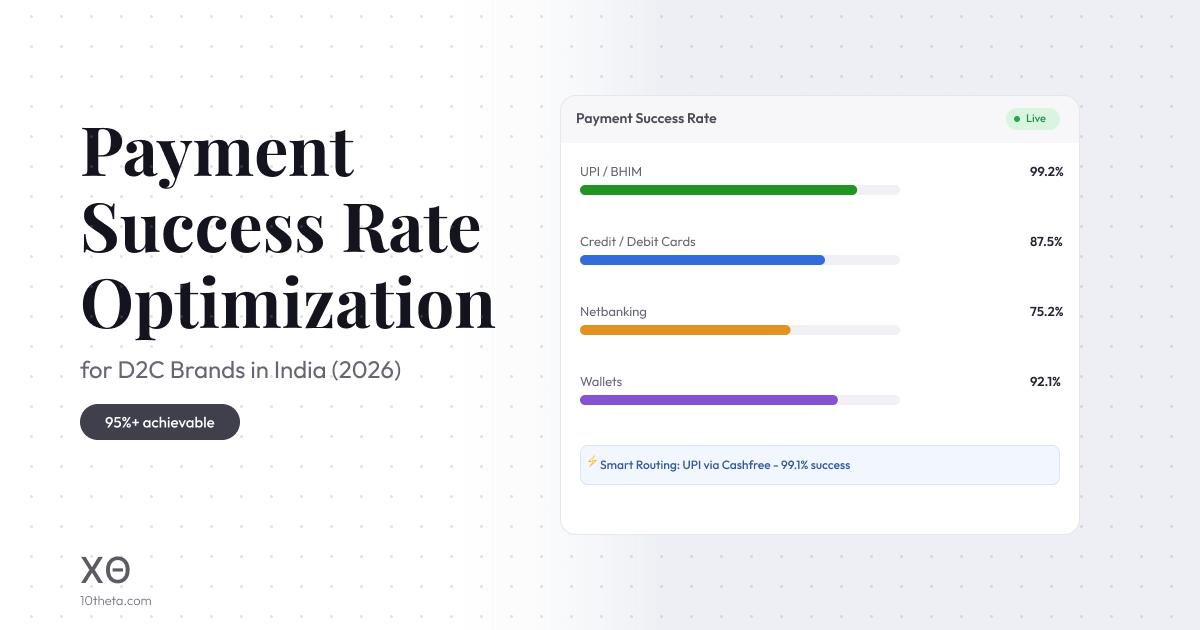
UPI has fundamentally changed the payment landscape in India, and D2C brands that haven't restructured their checkout around it are leaving money on the table. According to NPCI data, UPI's transaction success rate sits at 99.2% - the highest of any digital payment method in the country.
The comparison is stark:
- UPI: 99.2% success rate - direct bank-to-bank, no redirect, no OTP dependency
- Credit/Debit Cards: 85-90% success rate - 3DS OTP adds a failure point, bank page timeouts
- Netbanking: 70-80% success rate - redirect-heavy, session timeouts, browser compatibility issues
UPI now accounts for over 75% of India's digital payment volume, yet many D2C checkouts still show card fields first - a design pattern inherited from Western eCommerce templates. When you bury UPI under "Other payment methods" or show it as the third option after cards and netbanking, you are actively pushing customers toward payment methods with lower success rates.
The fix is simple: show UPI first. Make it the default selected option. Display the UPI QR code or intent flow prominently. For mobile users, trigger the UPI app selector directly. Brands that switch to UPI-first checkout design report 8-12% improvement in overall payment success rates within the first week - with zero additional cost.
3. Smart Payment Routing
No single payment gateway maintains 100% uptime across all payment methods, all banks, and all transaction amounts. Razorpay might have 99% UPI success but 88% card success at a given moment. Cashfree might be the opposite. PayU might be down entirely for HDFC netbanking while processing ICICI flawlessly. The success rate for any specific gateway fluctuates by the minute.
Smart payment routing solves this by maintaining connections to multiple payment gateways and routing each transaction through the one with the highest real-time success rate for that specific combination of payment method, issuing bank, and transaction amount. If Razorpay's UPI success drops to 92% due to a backend issue, transactions automatically route through Cashfree at 99%. No manual intervention required.
The impact is significant. Multi-gateway routing with real-time health monitoring typically improves overall payment success rates by 5-10%. For a brand doing ₹1.5 crore in monthly GMV, that 5-10% improvement translates to ₹7.5-15 lakh in recovered revenue per month. The implementation cost is negligible compared to the revenue it recovers.
Key routing parameters include: gateway-wise success rate by payment method (UPI, cards, netbanking), bank-specific success rates (some gateways perform better for specific issuing banks), transaction amount thresholds (some gateways have higher success for micro-transactions vs high-value orders), and time-of-day patterns (certain gateways perform worse during peak hours).
4. Automatic Retry and Failover
When a payment fails, the standard eCommerce response is to show the customer a "Payment failed. Please try again." message with a button. This is a terrible customer experience. The customer has to re-enter payment details, re-authenticate, and hope the same gateway doesn't fail again. Research shows that 60-70% of customers abandon after seeing a payment failure message.
Automatic retry changes this entirely. When a transaction fails on one gateway, the system silently retries on a different gateway or suggests an alternative payment method - all within the same checkout session, without the customer needing to re-enter anything. The customer sees a brief "Processing..." message instead of an error screen.
Effective failover strategies include: silent gateway retry (attempt the same payment method on a different gateway), method fallback (if card fails, immediately suggest UPI with a single tap), and session persistence (maintain the payment session so the customer never has to restart checkout). Brands implementing automatic retry and failover recover 30-40% of transactions that would otherwise be lost to payment failures.
The key is speed. The retry must happen within 2-3 seconds. If the customer waits more than 5 seconds staring at a loading screen, anxiety sets in and they are more likely to close the tab. Fast, invisible failover is what separates a 85% PSR from a 95% PSR.
5. COD-to-Prepaid at the Payment Screen
When a prepaid payment fails, many brands default to showing an error and hoping the customer retries. Smarter brands use the failure moment as an opportunity to convert what might become a COD order - or a lost sale entirely - into a successful prepaid transaction.
The strategy works in layers. When a card or netbanking payment fails, immediately surface UPI as the suggested alternative: "Card payment didn't go through. Pay instantly via UPI instead." If UPI also fails (rare, but possible during outages), offer COD as the fallback - but with a nudge: "Pay ₹99 now via UPI and the rest on delivery" or "Get ₹50 off - pay now via UPI."
This approach serves two goals. First, it saves the sale. A customer whose payment just failed is one tap away from abandoning - giving them an immediate, frictionless alternative keeps them in the checkout. Second, it keeps more orders prepaid. Prepaid orders have lower RTO rates (3-5% vs 25-40% for COD), lower operational costs, and better cash flow. Brands using smart COD-to-prepaid nudges at the payment failure screen convert 20-35% of would-be COD orders to prepaid, improving both payment success rates and downstream profitability.
6. Checkout UX That Reduces Payment Failures
Payment failures are not always technical. Poor checkout UX contributes to a significant percentage of failed transactions - slow page loads cause timeouts, confusing layouts lead to input errors, and unnecessary steps increase the window for things to go wrong.
The principles of a payment-optimized checkout for Indian D2C:
- Guest checkout by default - forced account creation before payment adds friction and another failure point. Let customers pay first, create an account after.
- Four steps maximum: Phone → OTP verification → Address → Payment. Every additional step loses 10-15% of customers.
- Address prefill - use saved addresses from previous orders or shopper networks to eliminate manual entry errors that cause delivery failures downstream.
- Progress indicators - show customers exactly where they are in the checkout process. Uncertainty causes abandonment.
- Payment method ordering based on history - if a returning customer always pays via UPI, show UPI first. If they prefer cards, show cards first. Personalized ordering reduces decision fatigue and speeds up checkout.
- Mobile-optimized payment flows - 85% of Indian eCommerce traffic is mobile. Ensure UPI intent flows trigger app selectors properly, card forms are thumb-friendly, and netbanking pages render correctly on mobile browsers.
These UX optimizations don't require gateway changes or complex integrations. They are frontend improvements that directly reduce the percentage of transactions that fail due to user error, session timeouts, or abandonment during the payment step. Combined, they typically improve payment completion rates by 8-15%.
7. How xθ Payθ Solves This
Payθ approaches payment success rate as an AI optimization problem, not just a plumbing problem. The system monitors real-time gateway health across multiple providers, automatically routing each transaction through the optimal gateway based on payment method, issuing bank, transaction amount, and time-of-day performance patterns.
EngageθWhen a payment fails, Payθ triggers automatic failover - silently retrying on a different gateway or surfacing an alternative payment method within seconds, before the customer sees an error screen. The COD-to-prepaid engine activates at the exact moment of failure, nudging customers toward UPI with contextual discounts rather than letting them fall back to COD or abandon entirely. Smart payment method ordering learns from each customer's payment history, showing their preferred and most successful payment method first.
The result: brands using Payθ consistently achieve 95-97% payment success rates, recovering revenue that was previously invisible in their analytics.
8. Measuring Payment Success Rate
You cannot optimize what you don't measure. Payment success rate (PSR) should be a daily metric on your dashboard, tracked with the same rigor as conversion rate and average order value.
Benchmarks for Indian D2C:
- >97%: Excellent - you are in the top tier. Focus on marginal gains.
- 95-97%: Good - room for improvement through smart routing and UX tweaks.
- 85-95%: Average - significant revenue leakage. Implement multi-gateway routing and UPI-first checkout immediately.
- <85%: Critical - you are losing ₹15-20 out of every ₹100 in attempted revenue. This needs urgent attention.
Break down PSR by payment method (UPI, credit card, debit card, netbanking, wallets, COD). This reveals which methods are dragging down your overall rate. Monitor gateway-wise performance to identify which provider is underperforming. Track PSR by time of day and day of week - some gateways degrade during peak hours. And critically, monitor PSR during sale events separately, when traffic spikes expose gateway capacity limits.
Set up automated alerts for PSR drops. If your UPI success rate drops below 95% or card success drops below 80% for more than 15 minutes, your operations team should know immediately. With Insightθ, these alerts are built in - along with gateway-wise dashboards that show real-time performance across all payment methods and providers.
What is a good payment success rate for ecommerce in India?
A good payment success rate for Indian ecommerce is above 95%. The industry average for D2C brands ranges from 80-85%, while top-performing brands with smart routing and UPI-first checkout achieve 95-97%. UPI transactions alone have a 99.2% success rate, so brands prioritizing UPI can significantly improve their overall PSR.
Why do online payments fail in India?
Online payments fail in India due to gateway downtime (30-35% of failures), bank OTP delays and timeouts (20-25%), session timeouts during netbanking redirects (15-20%), insufficient funds or card limits (10-15%), and network connectivity issues (10%). Single-gateway dependency amplifies failures - multi-gateway routing with automatic failover eliminates this risk.
How does smart payment routing improve success rates?
Smart payment routing dynamically routes each transaction through the gateway with the highest real-time success rate for that specific payment method, bank, and amount. If one gateway's UPI success drops, transactions auto-route through a better-performing provider. This typically improves overall success rates by 5-10% and eliminates single points of failure.
What is the UPI payment success rate in India?
UPI has the highest payment success rate in India at 99.2% according to NPCI data. This compares to credit/debit cards at 85-90% and netbanking at 70-80%. UPI's high success rate comes from direct bank-to-bank transfers with no redirect friction and minimal OTP dependency. D2C brands showing UPI as the default option see 8-12% higher overall payment success rates.
Sources & References
- NPCI - UPI transaction success rates and volume statistics (https://www.npci.org.in/what-we-do/upi/product-statistics)
- Razorpay - Payment success rate optimization benchmarks for Indian ecommerce (https://razorpay.com/)
- Baymard Institute - Checkout usability and payment failure research (https://baymard.com/)
Related Articles
- Switching D2C Checkout Providers
- Best Payment Gateways in India 2026: Razorpay vs Cashfree vs PayU vs Juspay
- One-Click Checkout Comparison India
- D2C Conversion Rate Optimization
- Reduce Cart Abandonment for D2C
- COD to Prepaid Conversion
- AI Voice Bot for D2C: Cart Recovery, COD Confirmation & Beyond
Every failed payment is revenue you earned but never collected.
Payθ optimizes every transaction with AI routing, automatic failover, and smart COD-to-prepaid nudges.
See Payθ in Action or calculate your revenue leaks for free ›