How to Increase AOV for D2C Brands in India: 8 Proven Strategies (2026)
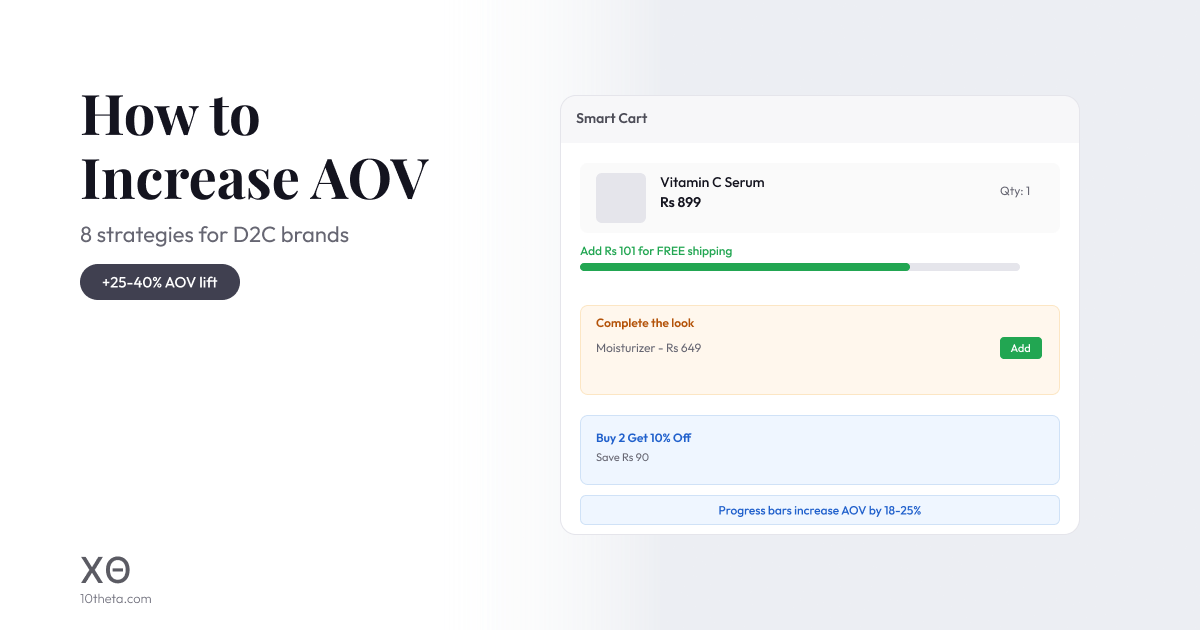
The average Indian D2C brand has an AOV of ₹800-1,200. Top performers push ₹2,000-3,500 using smart cart incentives, product bundling, and AI-powered cross-sells. Increasing AOV by even 25% has the same revenue impact as acquiring 25% more customers - without any additional ad spend.
Average Order Value is the most underleveraged growth lever in Indian D2C. Brands spend crores on paid acquisition, obsess over conversion rates, and pour resources into retargeting - yet ignore the simplest path to revenue growth: getting each customer to spend more per order. A 25% AOV increase on the same traffic delivers the same top-line impact as a 25% traffic increase, but at nearly zero marginal cost.
The D2C brands scaling profitably in 2026 are not just acquiring customers - they are engineering every cart interaction to maximize order value. Here are eight strategies that consistently deliver 25-40% AOV lifts.
1. Why AOV Matters More Than Traffic
Before diving into tactics, consider the math. Acquiring a new customer in Indian D2C costs ₹200-800 depending on your category - and that CAC is rising every quarter as Meta and Google ad costs inflate. But increasing AOV from customers who are already on your site, already browsing, already adding to cart? That costs almost nothing.
Here is the revenue impact laid bare: 10,000 orders per month at ₹1,000 AOV = ₹1 crore in monthly revenue. The same 10,000 orders at ₹1,300 AOV = ₹1.3 crore per month. That is ₹30 lakh per month in additional revenue - ₹3.6 crore annually - without spending a single extra rupee on ads, without acquiring a single new customer, without improving your conversion rate by a single basis point.
The leverage is asymmetric. Every ₹1 spent on AOV optimization returns more than ₹1 spent on acquisition because there are no marginal costs - no additional shipping, no additional packaging for the first item, no additional customer service overhead. The customer is already there. Your job is to help them buy more.
2. Progress Bar Incentives
"Add ₹299 more for free shipping" is the simplest and most effective AOV booster in eCommerce. Show a visual progress bar in the cart that fills up as the customer approaches a threshold - free shipping, a free gift, or a discount unlock. Brands using progress bar incentives consistently see 18-25% AOV increases.
The psychology behind this is the goal-gradient effect: people accelerate their effort as they get closer to a goal. When a shopper sees they are 70% of the way to free shipping, the impulse to close that gap is powerful. The key is setting the right threshold - typically 20-30% above your current AOV. If your AOV is ₹1,000, set free shipping at ₹1,249 or ₹1,299. Too high and customers ignore it; too low and you are giving away shipping without any AOV lift.
Cartθ implements dynamic progress bars that adapt thresholds based on cart contents and customer segments. A returning high-value customer might see a tiered bar - free shipping at ₹999, free gift at ₹1,499, 10% off at ₹1,999 - while a first-time buyer sees a single, achievable free shipping threshold.
3. Product Bundling
Bundling is the highest-impact AOV strategy for consumable and complementary product categories. Create bundles that offer 10-15% savings versus buying each item individually. "The Complete Skincare Kit" (moisturizer + serum + cleanser for ₹1,599 vs ₹1,897 separately) consistently outperforms selling each product alone.
Bundle AOV is typically 40-60% higher than single-product AOV. A brand selling a ₹699 moisturizer as its top SKU will see average cart values of ₹750-900 from single-product shoppers. The same brand offering a curated bundle at ₹1,599 will see bundle buyers at ₹1,600-1,800 AOV - and bundle buyers also have higher repeat purchase rates because they experience the full product range.
The most effective bundle strategies for Indian D2C include starter kits for new customers, replenishment bundles for returning buyers (3-month supply at 15% off), and gifting bundles during festive seasons. Position bundles as the default recommendation - not a hidden page - and show the per-unit savings prominently. "Save ₹298" is more compelling than "Get 15% off."
4. Smart Cart Upsells
The cart drawer is your highest-intent real estate. A customer who has added something to cart has already decided to buy - they just have not decided how much. Smart cart upsells show complementary products directly in the cart drawer: "Complete the look" for fashion, "Pairs well with" for beauty, "Don't forget" for essentials.
AI-powered cart upsells convert 8-15% of cart viewers into upsell buyers. The difference between AI recommendations and static rules is significant - static "you might also like" suggestions convert at 2-4%, while AI models trained on actual purchase patterns convert at 3-4x that rate because they surface products that real customers actually buy together.
Cartθ does this automatically. When a customer adds a kurta to cart, Cartθ analyzes purchase patterns to surface the dupatta or palazzo that 40% of kurta buyers also purchase - not a random accessory from the same category. The recommendation appears as a one-tap add in the cart drawer, with no friction and no page navigation required.
5. Cross-sell on Product Pages
"Customers also bought" sections are responsible for 15-30% of eCommerce revenue according to McKinsey's research. But the key word is "also bought" - not "also viewed." The difference matters enormously. Static cross-sell widgets based on category tags or manual merchandising rules show products that look similar. AI-driven cross-sells based on actual co-purchase data show products that customers genuinely buy together.
Effective product page cross-sells follow three principles. First, show products from complementary categories, not the same category - a customer viewing a protein powder does not need to see five other protein powders; they need a shaker bottle, a resistance band, or a pre-workout supplement. Second, limit choices to 3-4 items to avoid decision paralysis. Third, show the combined savings when items are purchased together.
For Indian D2C brands, cross-sell placement matters. Below the product description works for desktop, but on mobile (70%+ of Indian eCommerce traffic), a sticky "Frequently Bought Together" bar at the bottom of the screen outperforms in-page placements by 2-3x. Clareθ takes this further by enabling conversational cross-sells - when a shopper asks "What goes well with this?", AI recommends based on purchase data, not catalog rules.
6. Tiered Pricing and Volume Discounts
"Buy 2, Get 10% Off. Buy 3, Get 20% Off." Tiered pricing is one of the oldest merchandising strategies, and it works - especially for consumables like supplements, skincare, packaged food, and pet supplies where customers will eventually need refills.
Tiered discounts increase AOV by 30-50% on promoted products. The psychology is straightforward: the customer was going to buy one anyway, and the incremental discount makes buying two or three feel like smart economics rather than overspending. The per-unit saving becomes the justification for the higher total spend.
Effective tiered pricing for Indian D2C brands requires two things: clear display of per-unit savings ("₹499 each, or ₹899 for 2 - save ₹99") and logical tier jumps. Going from 1 to 2 should feel natural; going from 1 to 5 feels like wholesale, not retail. The sweet spot for most brands is a 2-tier structure (single + duo) or a 3-tier structure (single + duo + trio/family pack).
7. Minimum Order Value for Free Shipping
Free shipping is not a cost center - it is an AOV lever. Set your free shipping threshold 20-30% above your current AOV, and watch customers add items to qualify. If your AOV is ₹1,000, offer free shipping at ₹1,299. Over 60% of Indian online shoppers say they would add items to their cart to qualify for free shipping rather than pay ₹50-99 for delivery.
The math works in your favor. Shipping costs for most Indian D2C brands are ₹50-80 per order regardless of order value (within weight limits). If a customer adds ₹299 worth of products to avoid paying ₹79 in shipping, your gross margin on that incremental ₹299 far exceeds the ₹79 shipping cost you absorbed. You are effectively buying ₹299 in revenue for ₹79 - a 3.8x return.
Combine this with the progress bar strategy from section 2 for maximum impact. Show the gap visually, suggest specific products that would close the gap, and make the threshold achievable but not trivially easy. Brands that combine free shipping thresholds with progress bars and product suggestions see the highest AOV lifts - typically 22-30%.
8. Post-Purchase Upsells
Post-purchase upsells are the most risk-free AOV strategy that exists. After the customer completes checkout and sees the order confirmation page, show a one-click offer: "Add this to your order for ₹199 (50% off). Ships together - no extra shipping cost." The customer clicks once, and the item is added to their existing order. No re-entering payment details, no second checkout flow.
Post-purchase upsells carry zero cart abandonment risk because the primary order is already placed and paid for. The customer is in a moment of peak satisfaction (buying feels good), and the discounted offer feels like a bonus rather than a sales pitch. Conversion rates on well-targeted post-purchase offers run 5-10%, with some brands seeing 12-15% on deeply discounted add-ons.
The ideal post-purchase upsell is a low-cost, complementary product that ships easily with the main order. For a fashion brand, it might be a ₹199 accessory. For skincare, a ₹149 travel-size product. For supplements, a single-serve trial of a new flavor. The discount should feel substantial (40-60% off) because the goal is not margin on the upsell - it is incremental AOV and product discovery that drives future repeat purchases.
The Compounding Effect of AOV Optimization
These eight strategies are not mutually exclusive - they compound. A brand implementing all eight will not see 8x the impact of implementing one, but the combination typically delivers 25-40% AOV improvement. Consider the cumulative effect:
- Progress bar + free shipping threshold: Captures the "almost there" shoppers - 18-25% AOV lift
- Smart cart upsells: Adds complementary items at the point of highest intent - additional 8-15% of cart viewers convert
- Product bundling: Shifts customers from single-SKU to multi-SKU orders - 40-60% higher bundle AOV
- Tiered pricing: Increases quantity per order on consumables - 30-50% lift on promoted products
- Post-purchase upsells: Risk-free incremental revenue - 5-10% take rate
For a brand doing ₹1 crore per month at ₹1,000 AOV, a 30% AOV increase means ₹30 lakh per month in additional revenue - ₹3.6 crore annually. That is the equivalent of acquiring 30,000 additional customers per year at ₹0 CAC.
What is a good AOV for D2C brands in India?
The average Indian D2C brand has an AOV of ₹800-1,200. A good AOV depends on your category - fashion brands typically see ₹1,200-1,800, beauty and skincare ₹900-1,500, and supplements ₹1,500-2,500. Top-performing D2C brands push AOV to ₹2,000-3,500 using smart cart incentives, product bundling, and AI-powered cross-sells.
How do progress bars increase average order value?
Progress bars leverage the goal-gradient effect - a psychological principle where people accelerate effort as they approach a goal. When a shopper sees "Add ₹299 more for free shipping" with a visual bar showing 70% completion, they are compelled to add another item. Brands using cart progress bars report 18-25% AOV increases.
What is the difference between upselling and cross-selling?
Upselling encourages customers to buy a higher-end version of the same product - upgrading from a 100ml to 200ml moisturizer. Cross-selling suggests complementary products - recommending a serum alongside a moisturizer. Both increase AOV, but through different mechanisms: upselling increases value per item, cross-selling increases items per order.
How much can bundling increase AOV?
Product bundling typically increases AOV by 40-60% compared to single-product purchases. A skincare brand selling a ₹699 moisturizer can create a bundle at ₹1,599 (vs ₹1,897 individually), achieving over 2x the single-product AOV while offering customers 10-15% savings.
Sources & References
- McKinsey & Company - Product recommendation revenue contribution, 15-30% of eCommerce revenue (https://www.mckinsey.com/)
- Baymard Institute - Cart and checkout UX research, free shipping threshold impact (https://baymard.com/)
- Shopify - Average order value benchmarks and optimization strategies (https://www.shopify.com/)
Related Articles
- D2C Conversion Rate Optimization
- Reduce Cart Abandonment for D2C
- One-Click Checkout Comparison India
- D2C Unit Economics India
- 3 Hidden Data Patterns Every D2C Brand Should Track
Your cart is where revenue grows - or leaks.
Cartθ adds progress bars, smart upsells, and AI cross-sells that increase AOV by 25-40% - no code changes required.
See Cartθ in Action or calculate your revenue leaks for free ›